Archive for the ‘Happiness Notes’ Category
We’ve been HACKED and we’re bouncing back, hopefully soon! Many of our images and some of our content were deleted. We’re reviving and restructuring the entire site.
Explore our happiness quotes explaining how to create happiness and a happy life. Use the Search Box on the right to look for happy quotes and topics in this blog that are important to you. Enjoy HappinessHabit.com and Creating-Happiness.com!
Links to some of our most popular quotes for creating a happy life:
Dealing Distress & Despair: Don’t Beat Yourself Up! · Bouncing Back Quickly, Powerfully · Feeling Overwhelmed? · Dealing With Dangerous, Deranged Thoughts · Detach From Distress and Despair · Avoid The Fault Finding Feel Goods · Defeating the Dismal Downers · NEW – Happiness Habits For Veterans
Creating Happiness: Have A Good Time All The Time · YOUR Best · Savor, Enjoy, Appreciate · Forgiveness And Happiness · Fight With Finesse · What Are Habitually Happy People? · Can You Really Be Happy All of the Time? · Happiness Lessons From The Godfather · Love Powers Happiness · Happiness And Greatness · Happiness Without Hardness · Happiness And Pride · Happiness & Mastering The Art Of Living · Happiness And “Work”
Sadly, the Happiness Blog is being hacked – it’s been seeded with typos, links are being broken, sentences rearranged or garbled so they don’t make sense. We’re fixing these problems as fast as we find them. If you come across anything weird, please Tweet us or Comment to alert us so we can fix it. MANY THANKS!
Tags:create happiness, create happy, creating happiness, creating happy, happiness habit, Happiness Quotes, happy happy, happy quotes, michele moore
Posted in Happiness News, Happiness Notes, Happiness Quotes | 3 Comments »
 We all get them from time to time, those dreadful, dismal, dragging, despondent feelings.
What causes the Dismal Downers and what can we do to defeat or deter them?
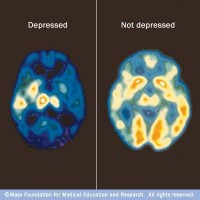
Photographs showing differences in brain activity when people are depressed – like this from the Mayo Clinic – may be familiar.
Reduced Brian Activity Is Associated With Depression. One of the keys to raising our spirits and defeating depression is to find ways to stimulate our brain activity.
Exercise – Many research studies show that regular rigorous exercise improves brain function and brightens people’s moods. This may be tied to improvements in the supply of blood flow to the brain.
Our brains represent about 2% of our body mass, but they consume about 25% of our body’s supply of oxygen. Brain function declines when brain blood flow declines. (Source: Massachusetts General Hospital “Mind, Mood & Memory” August, 2011)
Neural activity also stimulates blood flow to specific parts of the brain, but one’s heart and circulatory system must be strong enough to support the necessary increased flows.
Music – Many people also find music helps brighten their moods – the music stimulates their brains and their bodies into greater activity.
Stimulants – Other types of stimulants like alcohol, drugs or caffeine may produce the same effects but with negative consequences. They briefly raise blood pressure, alertness and mental activity but they also set us up for a reactive downer when the effects of the stimulants pass.
We can achieve many of the same things naturally without these negative consequences. This is why a brisk walk can do so much to brighten our mood and increase our mental alertness.
We can avoid overeating and dairy products and starches that make many people sleepy and slow.
We can choose to stimulate our own minds with lots of challenging, interesting thoughts. People who continually love to learn or acquire new skills or languages are found to retain their mental acuity into old age.
Habitually Happy people continually stimulate their minds with a constant stream of interesting, exciting, creative thoughts and mental activity. They think boredom is an inability to entertain ourselves when our environmental stimulation is low.
The Best Stimulation of All Is Happiness, Fun and a Good Time. Habitually Happy People Try To Have A Good Time All of The Time.
Why Not Try It, It’s A Great, Fun Way To Brighten Your Mood, Defeat The Dismal Downers and Sharpen Your Mind!
Copyright 1999- , Michele Moore. All Rights Reserved. Explore HappinessHabit.com and Creating-Happiness.com for more happiness quotes. Our materials may NOT be published, broadcast, redistributed or rewritten without written permission from the authors.
Tags:create happiness, create happy, creating happiness, creating happy, happiness habit
Posted in Happiness News, Happiness Notes, Happiness Quotes | 6 Comments »
 “Can you help me?” is a frequent response from veterans when I mention Happiness Habit skills. Here are highlights of what I say…
Wrap the Pain In Love – Remember what a big, warm, loving hug feels like? Whenever you need it, give yourself a big hug and wrap your pain, fear and bad memories in love.
When bad thoughts or feelings come to mind, picture yourself getting a great big warm hug and remember how great it makes you feel. Mentally give yourself that big, wonderful hug. Wrap the pain, the fear and the bad memories in love.
Enjoy that warm, loving hug for a few moments, and then immediately shift your attention to positive, constructive objectives. You don’t have to physically hug yourself to have this work well and nobody needs to know what you’re thinking or doing.
Our Happiness Habit research shows the happiest people are the most loving people – they love what they do, they love the people around them, they love their work and they love themselves. Wherever love is limited or lacking, there is no happiness. To be happy, try to love expansively and extensively.
Our Focus Determines Our Feelings – Thinking about bad things makes feel sad, angry or anxious. Shifting our attention to good things makes us feel happy, energized and enthusiastic.
That’s why it’s so important to move from problems to possible positive solutions quickly. Focusing on what’s wrong keeps us stuck in misery.
Painful visions and memories give us powerful jolts of Negative Energy, they are our own personal horror shows. Defuse those bad thoughts by wrapping them in love and then shifting attention to pleasant objectives. They are painful distraction from the happy life you want to enjoy.
Revolt & Rebel against letting painful past memories take control of your thoughts and feelings. Fight back and refuse to give them control. Wrap them in love and refocus your attention on being happy and whatever you are trying to achieve.
Happiness Is Healing – Happiness is the best way to put painful experiences behind us. Expect everything you do to be enjoyable and then try to make everything you do fun, interesting and rewarding.
Try To Have A Good Time All Of The Time. Fuel Your Life And Your Work With Love And Fun.
This posting will be expanded soon. Hope it helps!
Copyright 1999- , Michele Moore. All Rights Reserved. Explore HappinessHabit.com and Creating-Happiness.com for more happiness quotes and insights. Our materials may NOT be published, broadcast, redistributed or rewritten without written permission from the authors.
Tags:create happiness, Happiness Quotes, happy quotes, michele moore, vet, veterans, vets, war
Posted in Happiness Notes | 2 Comments »

Stuart Smalley - Saturday Night Live (Al Franken)
Saturday Night Live’s Stuart Smalley comes to mind whenever I hear the word Affirmations. Silly, nonsensical, comic.
Focus On What You Want To Achieve And The Steps You Must Take To Attain It is a key Happiness Habit.
We think it is critical to focus on your goals AND what you need to do to achieve them.
Repeating Positive affirmations over and over again, saying and pretending that you have already achieved your goals is delusional and counterproductive. This does not emphasize what you actually need to do to attain your goals.
Positive affirmations are very much part of our “The Secret” driven culture. They do everyone a serious disservice.
If you wander around pretending you already have achieved something you have not worked for, it’s easy to get lost in lies.
Here’s a paraphrased example of affirmations from a self help book I recently saw:
- There are two things you must know to reach a goal. First it must be clearly identified and quantified. Second, goals should be written and affirmed as if they already existed.
- To affirm something, you write and / or state it repeatedly, sincerely believing it has already been accomplished.
- Your affirmation might sound something like this: “I have sold five units as of January 30, 2011. Gross income from these sales is $500,000 and net profit is $80,000. I am respected and lead my field in sales production.”
- By expressing your desired outcome in the present tense, you condition your subconscious mind to accept it as fact. This method is taught by most success motivators.
- Write your affirmations several times each morning and evening. Post them on your bathroom mirror, refrigerator, your computer or car dashboard. Refer to them often and repeat them out loud. Believe them!
- By planting this seed of positive expectancy you condition yourself to move toward your goal swiftly and unswervingly.
Does this sound familiar? No where does it describe what you actually must do, or do differently to achieve these goals!
Wishing doesn’t make things real. Repeating affirmations over and over again detaches you from reality. If you truly believe it when you have not achieved it, it is delusional.
So focus on what you what to achieve and the steps you must take to attain it.
Positive affirmations do help you to step into the right mind set to perform and present yourself at your best. A successful salesman I know always says: “Cool, confident, successful and savvy” to himself before he walks into any room to remind himself of how he wants to think of himself and what we wants to project.
This helps him connect with a clear image of the person he wants to be – but it is very different from pretending and telling himself he has already done something he hasn’t worked to attain.
Use affirmations to help you to connect with your best self and then:
Focus On What You Want To Achieve And The Steps You Must Take To Attain It to achieve your dreams.
Copyright 1999- , Michele Moore. All Rights Reserved. Explore HappinessHabit.com and Creating-Happiness.com for more happiness quotes. Our materials may NOT be published, broadcast, redistributed or rewritten without written permission from the authors.
Tags:create happiness, create happy life, creating happiness, creating happy life, happiness affirmations, happiness habit, Happiness Quotes, michele moore
Posted in Happiness News, Happiness Notes, Happiness Quotes | 3 Comments »
 Our Aim Determines Our Achievements
If you want to be happy or happier, make happiness and enjoying life your goals.
Whatever you have to do, try to enjoy it! Find ways to make ALL your activities enjoyable, rewarding and meaningful.
Make Doing Well AND Feeling Well Your Top Personal Priorities
Expect to enjoy everything you do and then find ways to make everything you do enjoyable, meaningful and rewarding – for everyone involved.
Propel Your Life and Your Work With Fun! Continually create your own happiness.
Try To Have A Good Time ALL of The Time!
Sound simple? It is!
Learn how happiness works and start building happiness in your life.
Many people want to be happy but they expect happiness to magically descend on them, like a dove from heaven. They don’t know how to create happiness in their lives or for the people around them.
They don’t realize happiness is right there at their finger tips, waiting for them to reach out and enjoy it.
If you don’t make happiness a personal priority, happiness often only appears by accident or as an afterthought. Life is too short for that.
To Be Happy or Happier, Aim For Happiness. Make Happiness Your Goal and Work To Achieve It.
Copyright 1999- , Michele Moore. All Rights Reserved. Explore HappinessHabit.com and Creating-Happiness.com. Our materials may NOT be published, broadcast, redistributed or rewritten without written permission from the authors.
Posted in Happiness News, Happiness Notes, Happiness Quotes | 4 Comments »
 How are your New Year’s Resolutions doing? Are you happy with your progress?
Eager excitement and anticipation blaze in our New Year’s celebrations.
We are determined to make this year much better than the last which just gratefully passed.
Now, barely several weeks into the New Year, many of us feel the Gnawing Nags of Negativity signaling New Years Resolution Remorse.
We have not done and are not doing all of the things we were so enthusiastically determined to do.
The power of habits, inertia and the demands of life seem to be dragging us back into the same ruts we wanted to escape. So what do we do?
Here are a few key Happiness Habits to help you redouble your determination and desire to achieve your New Year’s goals and aspirations:
Don’t Beat Yourself Up – Criticizing and castigating yourself is damaging, demoralizing and very counterproductive. We do it because as children, adults punished us in efforts to improve our behavior, so we do it to ourselves thinking it will make us better. It doesn’t, it defeats us.
Expect Lapses and Plan for Them – Many successful personal development programs grow in fits and starts with great leaps forward alternating with relapses backwards. The key is to learn how to handle your relapses well.
Failure Is NOT Falling Down, It’s Staying Down – Giving up because you made a goof or series of goofs is a grievous condemnation and limitation on your future performance. Successful people make mistakes, they are also determined not be defeated by them.
Misery Is Meant To Make Us Move – Those Gnawing Nags of Remorse and Negativity are a powerful, helpful signs you are slipping back into patterns and behaviors you resolved to avoid. Say “Thank you Resolution Remorse, you are reminding me and reinforcing my resolve to achieve my goals.”
Redouble Your Determination, Drive and Desire – Your dreams haven’t changed, you are just disappointed in your recent actions to attain them. This doesn’t mean you can’t do it. Reinforce your resolve to work hard to achieve your goals.
Drive Discipline With Desire – Don’t view discipline as deprivation, see discipline as steps to dream realization. The secret to successful discipline is to always desire something positive more than whatever tempts you. Fire up and redouble your desire to achieve your goals.
See Small, Very Specific Steps To Success – Start small, construct your process as a series of small, very specific steps that lead to dream fulfillment. Continually celebrating successful completion of each step sets you up for a series of successes.
Lapses Mean You Have To Work Even Harder – Make up for your mistakes and work hard to catch up and stay on track.
Continually Recall And Reinforce Your Resolve – Remember and relive the feelings that lead to your resolution. Continually reinforce your desire and determination, rekindle your resolve to achieve your dream.
Happy New Year from Michele Moore and the Happiness Habit Team!
Copyright 1999- , Michele Moore. All Rights Reserved. Explore HappinessHabit.com and HappinessBlog.com. Our materials may NOT be published, broadcast, redistributed or rewritten without written permission from the authors. Photograph from Dreamstime.com
Tags:happiness habit, happiness secrets, happy life, happy people, michele moore, new years resolution remorse
Posted in Happiness Notes | 1 Comment »

Stabs of self pity strike suddenly from time to time.
All we see are the wrongs, the inequities and the dreadful damage our difficulties have caused us.
A overwhelming surge of painful, debilitating self pity begins to set in.
Don’t let self pity overwhelm or over power you.
Stop Self Pity Before It Grows And Deepens
Don’t give those negative, debilitating thoughts and feelings any time and attention, all they will do is bring you down. They are non productive, unnecessary and dangerous. Self pity sabotages happiness and brings dreadful, dismal, downward spirals of despair.
Revolt and Rebel Against Self Pity
Refuse To Give Those Painful Thoughts Your Time And Attention
Self Pity SOS – Let self pity’s first twinges serve as an SOS to immediately redirect your thoughts, actions, energy and attention toward positive goals, activities and objectives that will help you to be happy and spiritually successful.
Don’t Let Self Pity Down Your Spirits
Don’t Give Self Pity Your Time or Attention
Negative judgments power all fear, emotional pain, anxiety and despair. Self pity is a super charged negative judgment.
The normal response is to ask, can these negative judgments help me in some way? If the answer is YES, turn the negative judgments into a series of positive action items and constructive steps that build happiness and spiritual success.
“I’m going to be late!” is an anxiety producing negative judgment that can help you if you turn it into a series of positive actions items: I will stop what I am doing, watch the clock carefully, collect my things and get ready to walk out the door at least three minutes early.
If the answer is NO, discard the negative judgments and refocus your time and attention on activities that will help you achieve your goals, be happy and spiritually successful. The negative judgments are making you miserable for no reason.
Stabs of self pity signal an immediate jump to this NO response. Self pity rarely contains any positive action items that can help you to triumph and be happy. Feeling sorry for yourself is debilitating, dismal and no fun. Stop it before it grows and deepens.
When Stabs Of Self Pity Strike, Immediate Redirect Your Thoughts And Attention Toward Positive, Exciting, Encouraging Thoughts, Actions And Activities That Will Help You Succeed And Be Happy.
Copyright 1999- , Michele Moore. All Rights Reserved. Explore HappinessHabit.com and HappinessBlog.com. Our materials may NOT be published, broadcast, redistributed or rewritten without written permission from the authors. Photograph from Dreamstime.com
Tags:happiness habit, happiness secret, happy life, happy people, michele moore
Posted in Happiness Notes | No Comments »

A spirit of revolt and rebellion is important to happiness in normal times, it is especially important during difficult times.
Revolt and rebel against giving bad things and difficult people control of your feelings.
Don’t help them hurt you.
Don’t let them get you down, upset you or steal your time and attention.
Revolt and Rebel against giving them control of your feelings.
We are truly at our best and able to perform our best when we are Up, confident, energized, enthusiastic and happy. We want to continually try to be at our best so we can perform our best.
We don’t want to let bad circumstances or difficult people distract or detract from our ability to do well.
Continually Trying To Do Your Best, Feel Your Best And Be At Your Best Is A Key Happiness Habit.
Habitually happy people don’t like to hand control of their thoughts, actions or feelings over to people or circumstances that distress, depress, distract or demoralize them. They like to remain emotionally independent and spiritually free.
They revolt and rebel against giving bad things control of their feelings. They use pleasant experiences, interactions and people to elevate their feelings but they don’t let bad thing tear them down.
If you allow some jerk to make you angry, you have given then control of your feelings. You are allowing then to steal your time, your attention and your emotional well-being.
Instead, simply say to yourself, “I am NOT giving you control of my feelings. I am NOT giving you the power to hurt me. I will deal with you at a time and place that is good for me. I am not going to allow you to distract, distress, depress or demoralize me.” This is a learned skill that gets more powerful with practice.
It’s important to emphasize this does not mean revolt and rebel against the situation itself, which may or may not be a good idea. We often have to be conciliatory and comply in order to survive and succeed. It does mean not giving bad things the power to hurt you. See Happiness In Hard Times – Revolt and Rebel for more insights.
Revolt and rebel against giving bad things and difficult people control of your feelings. Don’t let them get you down, distract, depress or upset you or steal your time and attention.
Refocus your time and attention on activities that will help you to succeed, be happy and do well.
Copyright 1999- , Michele Moore. All Rights Reserved. Explore HappinessHabit.com and HappinessBlog.com. Our materials may NOT be published, broadcast, redistributed or rewritten without written permission from the authors. Photograph from Dreamstime.com
Tags:happiness habits, happy life, happy people, michele moore
Posted in Happiness Notes | 1 Comment »

When you are feeling overwhelmed and over powered by all the things you have to do, how can you stay sane, focused, balanced, confident, effective and happy?
Break Important Tasks Down Into Small, Specific Steps or Sections That Are Easy To Visualize And Achieve During A Short, Definite Period of Time.
Work As Hard As You Can, Complete That Step. Stop And Celebrate Success.
Assess your progress in terms of your larger goals and the time you have to attain them. Decide what to do next and how long you will spend on it.
Work as hard as you can, complete that step, stop, celebrate success, assess your progress and plan your next steps.
Great Achievements Are Built Through A Series of Very Small, Specific, Successful Steps.
If You Still Feel Overwhelmed, Break The Step Down Into Even Smaller, Shorter, Easy To Visualize And Achieve Steps or Actions.
Working Hard Is Energizing And Empowering – It Incites A Delight And Drive To Get Things Done. Urgency creates energy, determination, drive, decisiveness and focus. See work as an exciting series of successful achievements leading to valued goals, not a dreadful burden.
If You Can’t Face Getting Up And Moving – Take a couple of long, slow deep breaths. With each deep breath, feel energy coming into your body and radiating outward with each exhale. Smile confidently. Swing your legs around, take another deep, energizing breath, stand up confidently and smile.
Ask yourself, What Are You Going To Explore, Enjoy & Experience? What Are You Going To Appreciate & Achieve? What Are You Going To Accomplish So You Feel Good At The End Of The Day?
Priorities Are Key. Identify What Is Truly Most Important And Work On That Task. Don’t get distracted by busy work that allows you to avoid addressing important goals.
Planning Previews Success – Think carefully about what you want to achieve and the time and resources you have to accomplish it. Planning is a preview of your success.
Make Planning Previews Part Of Your Project’s Process.
Avoid The Fault Finding Feel Goods, Turn Negative Judgments Into Positive Actions and Avoid All UnNecessary, NonProductive Negativity.
You Will Feel Much Better And More Confident.
Copyright 1999- , Michele Moore. All Rights Reserved. Links to our website and pages are welcomed! Please note our materials may NOT be published, broadcast, redistributed or rewritten without written permission from the authors. Explore HappinessHabit.com for more happiness quotes and insights.
Tags:happiness habit, happiness secrets, happy life, happy people, michele moore
Posted in Happiness Notes, Happiness Quotes | 1 Comment »
 Disasters and deep disappointments are an inevitable part of life. Here are secrets to bouncing back quickly and powerfully:
Focus on Fixes – Ask yourself, what can you do to correct the problem, ensure it doesn’t happen again, gain from your pain, learn, grow, strengthen your skills and power to build happiness and future success?
Don’t Beat Yourself Up, Blame, Complain or Criticize! Focusing on where you are now and what’s wrong keeps you stuck in the problem and misery. Focusing on what you want to do differently and where you want to go in the future helps you to grow and achieve it.
We don’t feel better by blaming, beating ourselves up or by focusing on problems. Beating ourselves up reinforces errors we want to avoid. It focuses time and attention on what’s wrong, not on building new skills and strategies that bring happiness and future success.
We Bounce Back by embracing our goals, our Best Selves and by focusing on what we want to achieve and do differently and then working hard to attain it.
Turn Anguish Into Achievement – Turn anger, regret and anguish into positive actions that improve the situation and help you to be happy and more effective in the future.
Worrying about problems is very different from solving or resolving problems. Regret and remorse do not always cause reform. Desire and Determination To Do Things Differently Bring Positive Change.
Ask yourself, Is being upset helping me to fix the problem or to be more effective in the future? How long do I want to be upset? How miserable do I want to be and for how long?
Rebounding Rapidly: Think about how will you feel when the problem is behind you, when you have successfully rebounded. Visualize yourself successfully recovered from the problem. Feel those powerful positive feelings, embrace and project them. Practice feeling and being in rebound mode until it becomes habit.
We Can Rebound More Quickly By Focusing On How We Will Feel When We Have Rebounded From The Difficulty And Then Consciously Taking On Those Attitudes And Perspectives. Bad things happen but they don’t have to make you miserable for long.
Our Best: We are truly at our best and able to perform our best when we are UP, confident, energized, focused and happy. Don’t tear yourself down, distract or distress yourself. Don’t detract from your ability to excel and do well.
See Yourself At Your Best, Feel Those Powerful, Confident Feelings And Project Them. They Will Become Genuinely Yours. More Bouncing Back
Copyright 1999- , Michele Moore. All Rights Reserved. Links to our website and pages are welcomed! Please note our materials may NOT be published, broadcast, redistributed or rewritten without written permission from the authors. Explore HappinessHabit.com and HappinessBlog.com for more happiness insights.
Tags:happiness habit, happiness secret, happy life, happy people, michele moore
Posted in Happiness Notes, Happiness Quotes | 3 Comments »
 We are at our best and able to perform our best when we are Up, energized, enthusiastic and happy.
Habitually Happy People try to have a good time all of the time. They know this is the best way to perform well.
Summoning up energy, enthusiasm and determination to complete tasks well is just as important as defining good plans.
Decide what you are going to do and find ways to make work enjoyable, rewarding and meaningful. Fuel your life and your work with fun. When you make work fun you never have to toil again.
Loving your work, taking pride in what you do and finding ways to make it fun and fulfilling makes work flow effectively and efficiently.
“Ridiculous” cry critics, “You can’t expect to have fun and a good time all of the time!”
“I can!” Habitually Happy people reply, or “I can try.” “With an attitude like that you’ll never be truly happy!”
Habitually Happy People try to get the most from every moment, they try to have a good time all of the time. Because they try to find ways to enjoy life and work, they generally do.
They don’t allow themselves to waste time in self pity or in making their own misery. “Time spent in a down mood is time wasted” one happy person commented.
“You can choose your mood and attitude,” another happy person said, “I choose to try to be happy and feel good almost all of the time.”
They creatively reinvent tasks to make them fun, challenging and rewarding. They don’t tolerate down, distressed or dismal moods for long.
You Never Feel Better By Focusing On How Badly You Feel.
Explore, Enjoy And Employ Skills And Strategies Used By Habitually Happy People And Become Happier Yourself.
Make Happiness YOUR Habit!
Copyright 1999- , Michele Moore. All Rights Reserved. Links to our website and pages are welcomed! Please note our materials may NOT be published, broadcast, redistributed or rewritten without written permission from the authors. Explore HappinessHabit.com and HappinessBlog.com for more happiness insights.
Tags:happiness habits, happiness secrets, happy life, happy people, michele moore
Posted in Happiness Notes | 4 Comments »
 Of Course Not! All the Habitually Happy people we interviewed and studied said they experienced sadness, grief, distress, regret and various forms of mental malaise just like the rest of us.
Habitually Happy people are not immune to difficulties, they are not unfeeling, they are not unrealistically happy during devastating disasters, death or difficult times.
The all report occasional unexplained down times, dismal drearies, sadness for no reason. They generally bounce back quickly and report unexplained sadness often clears within a day.
Habitually Happy People are masters of using the power of love, positive expressions and enthusiastic feelings to buoy their spirits and to energize and encourage people around them. They know how to make the very best out of difficult circumstances.
Since they consciously try to enjoy, appreciate and have a good time all the time, they generally do. This shortens and lessens their periods of sadness.
Remember, Depression Is A Big Business. A great deal of money is made from misery, misinformation and manipulation. Beware of falling into its marketing trap.
Here are some key Happiness Habit® insights that can help:
The First Law Of Happiness: Our Focus Determines Our Feelings. Focusing our time and attention on bad things makes us feel sad, angry, worried or distressed. Shifting our attention to good things makes us feel energized, excited and enthusiastic.
Moving from problems to positive, possible solutions usually makes everyone feel much better.
Focusing On Doing Good Things Makes Us Feel Good.
Whatever We Focus Our Minds On
Expands In Our Experience.
We Never Feel Better Focusing On How Badly We Feel.
Exercising Excites Energy And Enthusiasm. Get Moving!
Action, Activity & Achievement Are Energizing, Encouraging, Empowering.
Take Positive Steps To Shake Off Sadness.
Copyright 1999- , Michele Moore. All Rights Reserved. Links to our website and pages are welcomed! Please note our materials may NOT be published, broadcast, redistributed or rewritten without written permission from the authors. Explore HappinessHabit.com and HappinessBlog.com for more happiness insights.
Tags:happiness habits, happiness secrets, happy life, happy people, michele moore
Posted in Happiness Notes | 4 Comments »
 To be happy, practice doing YOUR best, feeling YOUR best and being YOUR best self all of the time.
This helps you feel your best.
It illustrates The First Law of Happiness: Our Focus Determines Our Feelings.
When we focus on things we think are bad, we feel sad, angry, anxious or depressed. Shifting our attention to good things makes us feel energized, excited and enthusiastic.
Make it your goal to do YOUR best, feel YOUR best and be YOUR best all of the time.
It’s important to emphasize it’s YOUR best and not someone else’s best. How do we do this?
We all occasionally enjoy special, magical days when we are feeling, thinking and performing at our very best.
Remember those days in vivid detail. Recall how you felt, acted and thought. Describe it in clear, specific detail. People often say…
“My mind is alert, sharp, focused, I am able to concentrate very well. A relaxed powerful energy is flowing through my body. My spirit seems to soar with joy. My concentration is intense without my body feeling tense.”
Remember one of those special days, recall your thoughts and feelings. Feel the rhythm and beat of that marvelous, positive energy flowing through your body. Connect with those feelings and take them on for yourself. Project them and they will be yours.
You can’t be at your best while thinking about how badly you feel!
See yourself performing YOUR best, feeling YOUR best and thinking YOUR best. Feel those feelings, step into that zone, project those feelings and they will be genuinely yours.
You can now be at your best whenever you wish!
It’s a great way to be happy.
Copyright 1999- , Michele Moore. All Rights Reserved. Links to our website and pages are welcomed! Please note our materials may NOT be published, broadcast, redistributed or rewritten without written permission from the authors. Explore HappinessHabit.com and HappinessBlog.com for more happiness insights.
Tags:happiness habits, happiness secrets, happy life, happy people, michele moore
Posted in Happiness Notes | No Comments »
 Don’t Beat Yourself UP!
You Have To Be At Your Best To Perform Your Best.
Tearing Yourself Down Is Distracting, It Destroys Your Confidence And Detracts From Your Ability To Do Well.
Beating Yourself Up is very counterproductive.
You’re spending all your time, energy and attention focusing on what went wrong and how terrible it is and then you are burning it into your memory with lots of negative energy.
No time or attention is spent on identifying, learning and strengthening skills and strategies that will help you avoid the error in the future and build success and happiness.
Why do we Beat Ourselves Up?
When we were little, parents and authority figures may have punished us to protect us from the dangers of wrongdoing.
If we ran into a busy street without looking, we may have received a spank on the rump to discourage us from doing it again.
Punishment Causes Pain And Pain Prompts Avoidance.
What we really need to learn is to recognize there is danger, stop, look carefully both ways before we cross a busy street. Beating yourself up doesn’t teach the skills we need to survive and be safe and successful in the future.
On some level we also may have learned the wrong lesson, that beating ourselves up is the way to improve our performance and make ourselves better – so we do it to ourselves.
By focusing on where we are and what’s we did wrong we stay stuck. We reinforce our errors by rehearsing and reliving them in our minds
Beating Yourself Up Reinforces Errors You Want To Avoid.
Remorse and Regret do not necessarily bring Reform.
By focusing on where we want to go and what we want to do differently in the future, we grow.
Channel Anger And Anguish Over Errors And Mistakes Toward Fixing Problems And Identifying And Practicing Skills That Will Make You Successful And Happy In The Future.
Copyright 1999- , Michele Moore. All Rights Reserved. Links to our website and pages are welcomed! Please note our materials may NOT be published, broadcast, redistributed or rewritten without written permission from the authors. Explore HappinessHabit.com for more happiness quotes and insights.
Tags:happiness habits, happiness secrets, happy life, happy people, michele moore
Posted in Happiness News, Happiness Notes, Happiness Quotes | No Comments »
The Fault Finding Feel Goods are one of the biggest barriers to happiness and spiritual success. Avoid them if you want to be happy.
What are the Fault Finding Feel Goods?
The Fault Finding Feel Goods are all those terribly tempting tendencies to criticize, blame, complain or judge to elevate ourselves and our self esteem. 
The Fault Finding Feel Goods make us feel good on some level by putting other things or other people down.
The problem is that we’re focusing on negatives and that’s not the way to happiness or to spiritual success!
Since we feel good by complaining about what is wrong, we have no vested interest in trying to help improve it or change it.
This means we tend to stay stuck in our negativity and to continue wallowing in wrongs.
The Fault Finding Feel Goods take many forms… blame, complaints, judgmental criticism, ridicule and bigotry.
Have you ever met a critic who seemed really happy? Their primary source of joy is putting something or someone else down.
Recognize and Reject the Fault Finding Feel Goods if you want to be happy and spiritually successful.
Refocus your time and attention on positive, inspiring thoughts and actions that will help you to achieve, succeed and be happy.
Copyright 1999- , Michele Moore. All Rights Reserved. Links to our website and pages are welcomed! Please note our materials may NOT be published, broadcast, redistributed or rewritten without written permission from the authors. Explore HappinessHabit.com and HappinessBlog.com for more happiness insights.
Tags:happiness habits, happiness secrets, happy life, happy people, michele moore
Posted in Happiness Notes | No Comments »
 Huge increases in happiness come from simply deciding to avoid all unnecessary, non-productive negativity.
If the negativity is unnecessary and non-productive, resolve to avoid it.
Don’t give it your time and attention. Don’t repeatedly replay it in your mind.
Let it go. Focus on positive, productive activities and aspirations.
Sometimes you cannot physically escape. A boss, parent, loved one or authority figure may have the power to keep you there.
Listen, learn all you can but decide to be unaffected. Don’t give them the power to hurt you.
Smile, nod very nicely in bobble headed agreement while your thoughts and attention are focused on positive and productive activities far away.
Avoiding The Fault Finding Feel Goods and All UnNecessary, Non-Productive Negativity are powerful prescriptions for happiness and spiritual well being.
Copyright 1999- , Michele Moore. All Rights Reserved. Links to our website and pages are welcomed! Please note our materials may NOT be published, broadcast, redistributed or rewritten without written permission from the authors. Explore HappinessHabit.com and HappinessBlog.com for more happiness insights
Tags:happiness habits, happiness secrets, happy life, happy people, michele moore
Posted in Happiness Notes | No Comments »
When we are stressed and overwrought, it’s easy to loose sight of all the beauty and goodness that continually surrounds us.
Stop and spend time SEAing, Savoring, Enjoying and Appreciating simple pleasures that bring joy and happiness.
Deciding to use pleasant, enjoyable experiences to raise your spirits and refusing to let negative forces to drag you down is an important key to happiness.
 Savor Pleasing Sensations – warm sunshine on your face, a soft breeze on your skin, the taste of a favorite tea.
Enjoy Pleasant Experiences – great music, a brisk walk, a warm shower, working hard on valued activities, a good book.
Appreciate Activities that bring joy – admiring achievements, a beautiful sunset, acts of kindness, generosity and compassion.
Whenever you notice something wonderful or beautiful, resolve to spend a few special extra moments SEAing it too, Savoring, Enjoying and Appreciating its goodness to lift your spirits.
It’s a technique that elevates your mood and super charges your well-being whenever you need it.
Nothing around to Savor, Enjoy or Appreciate?
Recall and relive those special times when you felt absolutely marvelous. Use those memories to brighten your mood, energize, and expand your appreciation of the pleasant things in life.
Remember the energy and enthusiasm of an exciting day, the warmth of tender moments or the wonderful rubbery feelings of relaxation when you need to calm down.
Use pleasant experience in the present and in memories to brighten your mood whenever you wish.
When you SEE something wonderful, spend a few extra seconds Savoring, Enjoying & Appreciating, SEAing it too. It builds happiness.
Copyright 1999- , Michele Moore. All Rights Reserved. Links to our website and pages are welcomed! Please note our materials may NOT be published, broadcast, redistributed or rewritten without written permission from the authors. Explore HappinessHabit.com and HappinessBlog.com for more happiness quotes.
Tags:happiness habits, happiness secrets, happy life, happy people, michele moore
Posted in Happiness Notes | No Comments »
 Everyone has dangerous, deranged thoughts from time to time, even the happiest, most admirable, sane and stable people among us.
Dangerous, deranged thoughts can drive us crazy and do us great harm if we do not deal with them quickly, dramatically and effectively.
The Key to Happiness and Spiritual Success Is to Immediately RECOGNIZE Dangerous, Deranged Thoughts for What They Really Are, RAPIDLY REJECT Them and Immediately REDIRECT ATTENTION To Positive Thoughts, Actions and Objectives.
Don’t give dangerous, deranged thoughts time and attention to take hold. It’s always easier to step out of a shallow spot than having to climb out of a deep hole.
The Happiness Habit “Practice Being The Person You Want To Be” Is a Powerful, Positive Protector.
When you encounter bad, dangerous deranged thinking, immediately reject it and redirect your attention to answering the question, “How would the person I want to be think, act and feel, what would they do?”
Visualize yourself as the person you want to be, take on their perspectives and persona and “Practice Being The Person You Want To Be.” It’s that simple!
What are dangerous and deranged thoughts? Thoughts that are illegal, harmful or detrimental to your health and well-being or hurtful to others.
This illustrates The Three Fundamental Truths that are the Foundation of the Happiness Habit:
1) The most important decision we make on a moment to moment basis is where we focus our time and attention. The sum of these decisions is our life.
2) Whatever we focus our minds upon expands in our consciousness. Whatever we give time and attention to grows in our reality.
3) Thoughts have consequences just like actions have consequences. Beware of the Consequences of Your Thoughts is just an important warning as Beware of the Consequences of Your Actions!
Try it the next time you are hit with a dangerous, deranged thought.
Recognize and Reject Dangerous, Deranged Thoughts and Redirect Your Attention To Positive Activities and Objectives.
Copyright 1999- , Michele Moore. All Rights Reserved. Links to our website and pages are welcomed! Please note our materials may NOT be published, broadcast, redistributed or rewritten without written permission from the authors. Explore HappinessHabit.com and HappinessBlog.com for more happiness insights.
Tags:happiness habits, happiness secrets, happy life, happy people, michele moore
Posted in Happiness Notes, Happiness Quotes | 1 Comment »

Criticism And Control Occur So Frequently Together They Are Practically Synonymous.
Criticism Is Almost Always A Power Play.
People criticize to try to assert their superiority, power and to gain control of people, situations and interactions.
Critics assert control by planting doubts and disparaging or damaging ideas in people’s minds. They may or may not be factually correct or beneficial.
Criticism Is Corrosive.
Criticism leaves people deflated, demoralized, confused and uncertain about what they should do. That’s often the critic’s intent. Critics like to leave people feeling badly and powerless, that’s how they exert power and control.
If you can get a person to doubt themselves, their ideas or their abilities, it’s easier to control them, dominate them or at least get them to defer to your desires.
Doubt is often all you need to dominate and dissuade others from differing with you.
Criticism Is Counterproductive.
Criticism focuses on what’s bad, wrong or unattractive.
Calling something is bad does not describe what is good. Saying something is wrong does not express what is right or desirable. Describing what you don’t want does not not communicate what you do want.
Criticism only helps to the extent it expresses what to avoid. Criticism does NOT present clear descriptions of successful solutions, strategies or what you can do to improve.
Criticism Is Often A Deliberate Distraction – Critics criticize to derail other people’s success. Deflecting or dealing with criticism takes time, energy, attention and resources from positive, important activities. It’s easy to find yourself worrying about what critics say is wrong rather than focusing on what is truly important to you.
Focus On What You Want To Achieve, Articulate Benefits.
Habitually Happy people focus on what they want to achieve. They can describe why it is desirable, beneficial or attractive. Clear goals help define the steps to attain them.
They spend just enough time with wrongs so they can rapidly recognize and reject bad things. They then redirect their attention, energy and enthusiasm to positive activities that help them build happiness and spiritual success.
Focusing on why they are working and striving for their goals reinforces their desire and drive to achieve them.
Recognize Criticism for What It Usually Is – A Corrosive, Counterproductive Power Play.
Treat criticism like any other Negative Judgment: Ask can it help me in some way? If YES, turn those negative judgments into positive action items. If NO, don’t give critics your time, attention or concern.
Focus On What You Want To Achieve.
Enjoy Your Progress And Eventual Success.
Copyright 1999- , Michele Moore. All Rights Reserved. Explore HappinessHabit.com and HappinessBlog.com. Our materials may NOT be published, broadcast, redistributed or rewritten without written permission from the authors. Photograph from Dreamstime.com
Tags:criticism control, happiness habit, happiness secret, happy life, happy people, michele moore
Posted in Happiness Notes | No Comments »
 We all know a few special people who always seem to be truly UP, energized and happy. They light up a room and our lives with their presence.
They seem to be having a good time all of the time and continually radiate genuine joy.
They are very loving people. They love life, they love what they do and they love the people around them, they love themselves.
They live without prejudices and embrace the entire world eagerly.
They have high integrity. We trust, admire and respect them.
They are good decision makers and leaders.
They are high achievers who love creative challenges.
They always enthusiastically try to do their best, be their best and encourage others to be their best too.
They refuse to let difficulties or problems distress or bother them.
When they are down, it never seems to last for long.
Enthusiasm, Energy, Achievement, Integrity, Happiness and Joy Characterize Their Lives.
You know some of these special people. They are not the most prominent or powerful people we know but they certainly are the happiest. We may wish we knew how to be more like them.
Happiness Habit interviewed and studied Habitually Happy, genuinely joyous people from all different walks of life and life situations. We identified the key Values, Beliefs, Habits, Ideals and Boundaries characteristic of happy thought. We call these special qualities Happiness Habits.
If you choose to adopt and practice Happiness Habits, you too will become happy or happier despite what is happening to you and around you.
Explore and Enjoy HappinessHabit.com, HappinessBlog.com and HappinessInHardTimes.com Comment on our postings. Share your thoughts and insights.
Wishing you great happiness and spiritual success,
Michele Moore and the Happiness Habit® Team
Copyright 1999- , Michele Moore. All Rights Reserved. Links to our website and pages are welcomed! Please note our materials may NOT be published, broadcast, redistributed or rewritten without written permission from the authors. Explore HappinessHabit.com and HappinessBlog.com for more happiness insights.
Tags:habitually happy, happiness habit, happiness secrets, happy life, happy people, michele moore
Posted in Happiness Notes | 2 Comments »
 Over a period of several years, Happiness Habit interviewed and studied habitually happy, genuinely joyous people from many different walks of life and personal situations.
We studied and interviewed people who were cheerfully facing terminal illnesses, job losses and major life challenges.
We intentionally omitted people who seemed happy primarily because of success or good things happening to them, what we term “situational happiness”.
We wanted to answer the question, “What can we do to be happier?” given who we are and the challenges we face.
Our goal was to identify and articulate the key values, beliefs, ideals, habits and boundaries that lead to happiness and spiritual success and explain why they work so well.
We call these key qualities Happiness Habits.
Experience has shown that when people consciously choose to adopt and practice Happiness Habits they become happy or happier despite what is happening to them or around them.
Our mission is to share these key happiness skills summarized in simple statements what we call Coaching Credos that are easy to recall and apply.
If Happiness Habit® concepts are:
1) Consistent with what most people know and believe to be true about happiness. You decide.
2) Consistent with the best current scientific and academic research. They are.
3) Effective, actually help people live happier more spiritually successful lives. You decide.
Then the validity of our approach is proven.
what do you have to loose? Why not give it a try?
Explore and enjoy our Happiness Habit websites and decide for yourself!
Copyright 1999- , Michele Moore. All Rights Reserved. Links to our website and pages are welcomed! Please note our materials may NOT be published, broadcast, redistributed or rewritten without written permission from the authors. Explore HappinessHabit.com and HappinessBlog.com for more happiness quotes and insights.
Tags:happiness habit, happiness research, happiness secrets, happy life, happy people, michele moore
Posted in Happiness Notes | No Comments »
Do You Want To Be Cool Like Barack Obama?
A Key Happiness Habit is:
Don’t hand control of your thoughts, actions or feelings over to outside forces or people who try to hurt or harass you.
Don’t Give Them Emotional Control Over You.
 Decide How You Are Going To Think, Act and Feel.
Choose Your Mood and Your Attitude.
Emotional Independence, Freedom and Balance are key Happiness Habits.
This does NOT mean that you don’t get angry or that you don’t decide to take decisive corrective action when necessary.
It does mean you weigh options carefully, decide when and how you will act and that you don’t just automatically react in anger.
Choose the timing, the place and substance of your response carefully.
We all have an Optimal Best Self – a sweet spot or optimal zone where we feel our best, do our best and perform our best. Habitually Happy people try to maintain their optimal Best Self State all of the time. Getting angry and irrational is not part of their process.
Much has been written about Barack Obama’s Cool calm demeanor. His actions and reactions epitomize Emotional Independence. He decides how he will act, react and project himself. He doesn’t let outside forces control his emotions easily.
If you let another person make you angry, you’re giving them control of your thoughts, actions, feelings and your well-being. Don’t do it!
Don’t Help Them Hurt You.
The next time someone tries to hook you into an angry response, simply think, “I’m not giving you control.” It’s that easy.
This does not mean stuffing your feelings or suppressing your emotions. It means not giving them control over you, your attention or your emotions.
Channel Anger Into Activism And Actions That Achieve Positive Goals.
Choose Emotional Independence and Spiritual Freedom. It’s that easy. Decide how you’re going to act, don’t simply react to them. Take command and lead interactions in the direction you want to go. Make this a Happiness Habit.
It’s a great way to stay cool and happy!
Copyright 1999- , Michele Moore. All Rights Reserved. Links to our website and pages are welcomed! Please note our materials may NOT be published, broadcast, redistributed or rewritten without written permission from the authors.
Explore HappinessHabit.com and HappinessBlog.com for more happiness insights!
Tags:calm obama, cool obama, emotional independence, happiness habit, michele moore, spiritual freedom
Posted in Happiness Notes, Holiday, NoTweet | 4 Comments »
We’re often asked how trying to do your best brings happiness…
Habitually Happy People Continually Try To Do Their Best, Feel Their Best, Be Their Best All Of The Time. Their Best keeps getting better.
It’s a direct application of The First Law of Happiness: Our Focus Determines Our Feelings. When we focus our attention on things we find bad, we feel sad, angry or anxious.
When We Think About Good Things We Feel Elevated, Excited, Energized. Our Focus Of Attention Determines Our Feelings.
If you’ve ever had a mediocre day when you just didn’t feel like putting forth a good effort and didn’t, you know the truth of this phrase.

When we don’t bother to try to do a good job and get only mediocre results, we feel pretty mediocre too.
Habitually Happy people continually energize themselves with thoughts of themselves doing their best at whatever it is they are doing.
Clear Goals Help Define The Steps To Attain Them.
Because they are thinking about doing well, they are able to do well and they feel well. Thinking about doing YOUR best provides a path to continually improve your performance.
The Key Word Here Is YOUR Best, Not Someone Else’s Best.
Learn all you can from other people’s superb performances and then try to do YOUR best. It’s the best you can realistically do.
Comparisons to superior star performers are often purposeless and painful for no reason. What good does it do to judge in comparison with the best unless you pull positive actions items for personal improvement from the process?
Powerful positive images of what you want to achieve are inspiring and invigorating. Working hard to achieve a worthwhile goal is satisfying and stimulating.
When you know you have done YOUR best you can let go of results on some level knowing you can do no more.
Continually Trying To Do YOUR Best Is A Key To Happiness.
Try To Do YOUR Best, Be Your Best, Feel Your Best All Of The Time.
Copyright 1999- , Michele Moore. All Rights Reserved. Links to our website and pages are welcomed! Please note our materials may NOT be published, broadcast, redistributed or rewritten without written permission from the authors. Explore HappinessHabit.com and HappinessBlog.com for more happiness insights!
Tags:happiness habit, happiness secrets, happy life, happy people, michele moore
Posted in Happiness Notes | 2 Comments »
The Happiest People In The World Are The Most Loving People. They are very kind, caring, compassionate and generous.
To be happy, love extensively and expansively. Love what you do, love the people around you, love your work and love yourself.
Wherever love is limited or lacking, there is no happiness.
Many people chase after success thinking it will bring them happiness but there are lots of very successful people who are Not especially happy.
Happiness and Success Are Two Very Different Things.
The best way to excel and do well at anything is to cultivate a love for what you are doing.
The Best Way To Be Happy Is To Love Extensively, Expansively.
Copyright 1999-2009, Michele Moore. All Rights Reserved. Links to our websites and pages are welcomed! Please note our materials may NOT be published, broadcast, rewritten or redistributed without written permission from the authors. Explore HappinessHabit.com for more happiness insights!
Tags:happiness habit, happiness love, happiness secrets, happy love, happy people, michele moore
Posted in Happiness Notes | 1 Comment »
 The path to happiness is universal, open to everyone, everywhere.
But is making happiness our top priority right for everyone?
Should we all put happiness first in our personal, family and business lives or do other priorities weigh in as more important? That’s for each of us to decide.
For some of us other things are more important than happiness… security, social significance, power, prominence, or perhaps creativity or making a lasting, important, indelible impact or contribution.
The world is a far richer, more delightful place because of Steve Jobs. His vision and determined dedicated leadership have changed the world. One would not say he has taken the traditional route to happiness.
No doubt he has achieved great happiness but in different, unusual ways.
We all can’t be Steve Jobs and Steve Jobs needs the rest of us doing what we are doing for his business model to succeed.
There are many different paths to happiness, but the qualities and characteristics of a happy life remain constant.
Money, success and power take precedence over happiness for many people. Many people could easily have both if the knew how to balance the two.
Greatness in any field requires sacrifices, but it also definitely has its rewards.
We can be happy and great at what we do. The truly great allow happiness to help propel their exuberant zeal to excel and do well.
Explore HappinessHabit.com for additional happiness resources.
Copyright © 1999- , Michele Moore. All Rights Reserved. This material may NOT be published, broadcast, distributed or rewritten without permission from the authors.
Tags:happiness, happiness resources, happy, happy life, happy people, michele moore, steve jobs
Posted in Happiness Notes | 1 Comment »
 Valentine’s Day Is a Reminder to Love… Ourselves and Others, Every day.
If you’re in a relationship… it’s a special, exciting day! Think of all the wonderful, kind, loving things you’ll do – choose one and decide to do it every day from now on.
Put a little Valentine’s Day in every day.
Maybe it’s beginning each day with a smile, a hug and an “I love you.” Or replacing one indifferent or distant habit with love and affection. Welcome them at the door or ask about their day and really listen.
One simple, small thing to add affection and care all year round.
Single, On Your Own?
Give yourself big hugs all day and enjoy the warmth of each loving, happy hug. Feel love in your heart, make a special effort to radiate it to everyone around you.
Enjoy, appreciate and delight in who you are and what you do. Resolve to do this at least once a day, every day from now on.
Enjoy and relish your own company, plan to take yourself out for a nice meal another, quieter day. Enjoy a solo adventure.
There’s a marvelous freedom and power in being happy on your own, in creating and carrying your own happiness within you where ever you go.
Reject myths saying we need a “relationship” to make us happy and complete, messages that make singles feel defective, needy and dependent. They say we should look to others for happiness when its true source lies within ourselves.
It’s the loving relationships and loving communities we create around us daily that bring expansive, enduring joy. They can easily be extensive, everywhere.
We can’t be happy in a “relationship” when we are not happy on our own. Resolve to love yourself and be happy on your own, right now.
For Everyone…
Make a special effort to radiate love and joy to everyone around you. Smile, seek out someone who is lonely and despondent, give them a special hug, remind them they are loved.
Copyright © 1999- , Michele Moore. All Rights Reserved. This material may NOT be published, broadcast, distributed or rewritten without permission from the authors.
Tags:happiness, happiness habit, happy, happy relationship, joy, love, michele moore, valentine
Posted in Happiness Notes | 3 Comments »
 Pride Is One of the Most Important and Misunderstood Aspects of Happiness
Pride in a job well done, pride in doing the right thing, in your accomplishments, your integrity or in the family you raised, are all very positive and healthy.
Pride Is An Important Part of Feeling Good About Ourselves, It Is a Healthy Part of Happiness.
Pride can also be a very bad, dangerous defect. What’s the difference? Here are some examples…
False Pride – Places too much emphasis on what other people may think or how they may react. Other people’s opinions of us run our lives. We become directed by fears and concerns about what other people think. False pride can prevent us from seeking and accepting the help we need to survive and thrive. False pride can cause us to try too hard to impress other people.
Superior Pride – Raises people up and places them above others, separating and isolating them with an inflated sense of self importance. We all know people with stuck up superior pride, they are attractive only to themselves. Their attitude says, “I am better than you and the rest of the world.”
Perfectionistic Pride – Demands that things be perfect in order to be acceptable and that we accept only the very best. Anything less is inferior and unworthy. Perfectionistic pride wastes time, resources and destroys happiness. It is exclusive and exclusionary. Perfectionistic pride limits our willingness to explore, try new things, to enjoy differences.
Each of These Negative Forms of Pride Defeat Our Desires to Be Happy and Spiritually Successful. Recognize and reject them and replace them with happy, successful responses.
How Do We Decide If Pride Is Positive or Perverse? Ask, is it helpful or hurtful? Does our pride expand and enhance our lives and opportunities or does it limit them? Is it a genuine expression of love, delight and affection? Or is it a twisted, limiting, false elevation and pseudo enhancement of self?
Trumpeting Triumphs is Not Bragging! Celebrating successes, trumpeting triumphs and delighting in good deeds all motivate us to do more and are important to happiness, enthusiasm and success. Bragging is very different. Bragging says, “I am better than you are…!”
Trumpet Triumphs, Celebrate Successes, Delight in Good Deeds, All Are Part of Healthy Pride and Are Keys to Happiness and Spiritual Success!!!!
For more see: Happiness Habit.com
Copyright © 1999 – , Michele Moore. All Rights Reserved. This material may NOT be published, broadcast, distributed or rewritten without permission from the authors.
Tags:happiness, happiness habits, happy, michele moore, pride
Posted in Happiness News, Happiness Notes | 1 Comment »
 Happiness Lessons From the Godfather
The Godfather movie trilogy illustrates many valuable Business and Leadership lessons.
It also illustrates some very important Happiness Habits, most importantly, the Dangers of Departing from Goodness.
In the beginning of Part I, young Michael Corleone is happy, idealistic and moral. He comes home from WWII as a hero. He wants to stay clean and clear of the family “business.”
He stayed happy and clean until his father’s life and “business” were threatened. He changed direction and killed two people.
As the trilogy continues, Michael is drawn deeper and deeper into violence, criminal dominance, alienation from goodness and separation from his family.
When the Godfather Part III ends, Michael is alone. He has it all financially, but nothing spiritually or emotionally. He has lost his family, his loved ones and himself. He is empty and desolate.
He has supreme success in a life of crime. In time, a rival may kill him and end his misery. What does he have to live for? To look forward to? To strive for?
Don’t Depart From Goodness
Make Goodness Your Guiding Goal
Always Try To Do Your Best, Be Your Best, Follow The Best Path You Know
No matter how things turn out, you know you did your best and you could do no more. You are blameless and your conscience will be clear. A clear conscience is central to all happiness and spiritual success.
Copyright © 1999- , Michele Moore. All Rights Reserved. This material may NOT be published, broadcast, distributed or rewritten without permission from the authors.
Tags:godfather, happiness, happiness lessons, happy, michele moore
Posted in Happiness News, Happiness Notes | 1 Comment »
 What makes for happy, successful lives and relationships?
Friendship, Trust and Teamwork
There is no greater gift than to help a person achieve their goals.
Good happy relationships help people achieve their goals and their dreams!
“But we’re so different!” is a frequent concern. People who work, live or spend time together happily and successfully grow together over time. We are enriched by differences and learn from them.
Key questions to ask…
- Are our goals the same? Do we want to achieve the same things? Do we want to travel to the same destinations in five, ten and twenty years?
- Is my life truly better with them or without them?
- Are our values the same?
- Are we compatible, do we enjoy spending time together?
- Do I have FUN with this person? Do they make me laugh?
Do Your Homework Before Becoming Involved
Spend time building friendship, trust and teamwork. If you can’t do it early in a relationship, you probably won’t be able to do it later once your emotions are hooked.
There’s a big problem with allowing sexuality to drive relationships. A person who is inappropriate but sexually attractive draws us into situations that are not good for us. The relationship supplies sexual highs but none of the key components of a good, healthy, successful relationship.
Friendship, trust and teamwork carry relationships over long distances and through difficult times towards happiness, success and achieving our dreams.
Focus on Friendship, Trust and Teamwork for happy, spiritually successful relationships!
See Happiness Habit for more happiness resources.
Copyright © 2007, Michele Moore. All Rights Reserved. This material may NOT be published, broadcast, distributed or rewritten without permission from the authors.
Tags:happiness, happiness habit, happiness resources, happy, happy relationships, michele moore
Posted in Happiness Notes | No Comments »
 Why do we often embrace, expand and wallow in our emotional pain?
Emotional Pain Is A Powerful Distractor That Robs Us of Happiness and Spiritual Success.
Engaging In Unnecessary Pain is Masochistic. So why do we do it?
Emotional pain is a powerful source of negative energy that seizes and holds our attention. It’s nature’s way of saying we need to stop what we’re doing to take care of things.
Thinking About Bad Things, and Reliving Painful Scenarios Gives Us Powerful Jolts of Negative Energy. They Are Our Own Personal Horror Shows.
We are both energized and made miserable by this emotional pain. I’s a source of negative energy that brings misery.
Sources of energy are attractive to us… laughter, love, thrills, great music, exercise, elevating experiences, sexual attractions, triumphs and achievement. Emotional pain that gives us jolts of negative energy is also attractive, but in a misery making way.
Remembering and Reliving Misery, Reinforces Our Misery. Reliving distressing situations becomes our own personal horror shows. They gives us jolts of energy with a large negative toll.
Recognize it for what it is, a jolt of negative energy from a bad source. Ask yourself,
“Is this positive or productive?”
“Is this helping me in some way?”
“Is this the best use of my time and attention?”
If not, detach and decisively resolve to NOT to give it a moment more of your time, attention or well-being. Painful thoughts are robbing you of pleasant present opportunities for no reason.
Detach and Distract Yourself from Destructive Misery, Distress and Despair.
Resolve to Direct Your Attention to Positive, Pleasant Solutions, Opportunities and Activities.
See Happiness Habit for more happiness resources.
Copyright © 1999- Michele Moore. All Rights Reserved. This material may NOT be published, broadcast, distributed or rewritten without permission from the authors.
Tags:despair, distress, emotional pain, happiness, happiness habit, michele moore, misery, pain
Posted in Happiness Notes, Happiness Quotes | 1 Comment »
 Habitually Happy people are amazingly altruistic. They rarely pass up a chance to be kind when it costs them little or risks them little.
Practicing Continual Kindness Is A Way To Be Happy.
They are also very adept at protecting themselves, pursuing and achieving their goals. They are not “people pleasers,” they do good because it makes them feel good.
It’s an example of the First Law of Happy Thought:
Our Focus Determines Our Feelings.
When We Focus Our Time, Attention and Energy On Doing Good We Feel Good. More importantly…
We can’t expect others to treat us well if we don’t extend the same care, concern and compassion we want from them to them.
I recently heard a noted economist speak on the subject of giving at a church stewardship dinner. He relayed recent studies linking charitable giving to happiness, but missed a few key points:
Altruism Is Attractive – We tend to like and trust altruistic people because we believe they place goodness, right action and the welfare of others on an equal plane with their own concerns.
It’s hard to like or trust selfish people who don’t show integrity.
Make Goodness A Guiding Goal – Doing good makes us feel good. Giving appropriately makes us feel good because we know we are contributing to worthwhile causes. And the flip side is…
When we don’t feel good about our actions, we can’t truly enjoy the rewards those actions bring. Try the Gold Fish Test – if the world knew the details of your actions, how would you and they feel? Worry isn’t worth it, secrets cause stress.
Love Not Logic Prompts Giving – People need clear, compelling visions of the benefits their gifts provide and a love for the cause in order to support them enthusiastically.
It’s a twist on the old sales adage, “Logic makes people think, emotions make them act.” Build benefits and love before asking for expanded contributions.
There’s an important difference between really wanting to do something and feeling we must, ought or have to do it.
Love Propels Happiness And Giving – Demonstrate how to feel good, proud and joyful about giving. Drive giving with desire.
Acquire The Qualities You Admire In Others – Seek good role models and visions of excellence which help to define the steps to achieve them.
Truly happy, successful people are usually very kind, caring, honest, charitable and compassionate.
Look Like and Live Like the Leaders You Admire. You’ll find they usually give very generously.
Action, Activity and Achievement Are Keys To Happiness. Doing Good Makes Us Feel Good.
Explore HappinessHabit.com for more happiness insights.
Copyright © 2007, Michele Moore. All Rights Reserved. This material may NOT be published, broadcast, distributed or rewritten without permission from the authors.
Tags:giving, goodness, habitually happy, happiness habit, happy, love, michele moore
Posted in Happiness Notes | 3 Comments »
Many people who truly love their work never want to retire. Then time or mandatory retirement catches up with them and they have no choice.
People who dislike their work can’t wait until the magic time comes.
The question everyone faces is… Then what?
Is a life of leisure all it’s cracked up to be?
What’s the secret to a happy retirement?
If you’re retired and NOT happy, try this…
Find something that makes you mad as hell and go fix it. Or decide to fix a small part of it you can influence and improve. Find something meaningful and worthwhile to devote your life to and work at it diligently.
Find ways to make the world or part of it a better place.
Personal purpose and productivity are important keys to happiness.
A retired banking acquaintance who maintains two large homes and has traveled widely recently quipped,
“Retirement is not all it’s cracked up to be.” He’s a cynic who describes himself as “skeptical” and likes to poke fun at my happiness endeavors.
“Travel?” I asked.
“Be there, done that,” he replied. “We’ve been every where we want to go and there’s no where we want to go back.”
“Passions?” I inquired.
“I don’t have any,” he answered.
“Volunteer work?”
“Did plenty of that while I was at the bank” he answered. After he walked away I realized what he probably really needed was a challenge, something to sink his teeth into.
We spend our lives building and creating businesses and professional careers. Then we walk away thinking our lives will be better when we don’t have to do anything at all. For some it is, for many it is not.
A friend who winters in Naples, Florida comments that many senior executives retire there and then die quickly in three to five years. Their minds and spirits are invigorated by the business challenges they face. Without them, they expire.
It’s as if the universe is saying, You’ve spent your life making money, now it’s time to give back or you may die quickly.
Find a challenge you can sink your teeth into. Make the world a better place. Find something that makes you mad as hell and go fix it. It’s a great way to feel happy, productive and enjoy a long retirement.
See HappinessHabit.com for more happiness insights and resources.
Copyright © 2007, Michele Moore. All Rights Reserved. This material may NOT be published, broadcast, distributed or rewritten without permission from the authors.
Tags:happiness, happiness habit, happy retirement, michele moore
Posted in Happiness Notes | 3 Comments »
Defend Your Happiness – Your good mood, your spiritual freedom and your turf against people, events and things that might take them away!
http://FightwithFinesse.com explores the Fine Art of Cheerful Corporate Combat.
Continually Radiate Confident, Relaxed, Energized Well-being.
Smile As You Speak. Speak slowly, project your words powerfully and purposefully. Talk to the back of the room. Push back with positive personality. Adopt an aura of amused, attractive assertiveness.
Emphasize Positives – Benefits, advantages and rewards of your position and suggestions. Avoid personal attacks, criticism and character assassination.
Don’t Disagree, Argue or Say, “No!” State contrary positions in clear, concise, positive, compelling terms. Emphasize and expand the benefits and rewards of your position and the dangers of doing things differently.
Base Your Position on Good Goals and High Ideals EVERYONE Can Embrace and Few Can Fault.
Don’t React Emotionally – Hold on to your personal power. Reacting to an adversary’s attacks gives them control over your actions and feelings. Chart your own course, don’t give them control.
Hook Attention with Abundant Positive Energy – Agree and direct the discussion your way. Positive energy attracts attention and makes people want to listen.
Don’t Look to your Audience for Approval. Seeking approval gives adversaries power and control over your feelings.
Remember Rebellion and Revolt Fuel Happiness – Revolt and rebel against anyone and anything that tries to control you, drag you down or depress your positive spirits. Don’t give adversaries control of your thoughts or feelings.
Continually Radiate Confidence and Relaxed, Energized Well-being. Try to touch everyone you meet with a positive spirit.
For more happiness habits see HappinessHabit.com
The Fine Art of Cheerful Corporate Combat – FightWithFinesse.com
Copyright © 2001-2007, Michele Moore. All Rights Reserved. This material may NOT be published, broadcast, distributed or rewritten without permission from the authors.
Tags:fight finesse, happiness, happiness habit, michele moore
Posted in Happiness Notes | 1 Comment »
 Work Is A Series of Steps To
Success, Achievement
And Satisfaction
The word “work” conveys wonderful feelings and images…
A “work of art” describing special beauty, or…
“life’s work,” the pride and satisfaction we gain from personal and professional achievements.
Work is wonderful.
For other people, “work” means misery, difficulty and pain.
Anything associated with “work” must be avoided at all cost.
“Work” is by nature unattractive, burdensome and distasteful.
“Work” deprives us of fun and enjoyment.
Habitually Happy people enjoy very different perspectives. They view “Work” as steps to success and achievement. They love to achieve and succeed so they always try to enjoy their work.
Habitually happy people decide what they are going to do and then they decide to find ways to enjoy it. The best way to excel and do well at anything is to cultivate a love for what you do.
They know viewing something they have to do as dreary, difficult or distasteful allows bad attitudes to work against them. They align their attitudes to support their goals, ambitions and decisions.
Even dull, repetitive work feeds families and allows people to pursue hobbies and higher goals. Take pride in doing simple things extraordinarily well.
View Work As Steps To Success And Achieving Your Goals. Relish and enjoy each step and you will never toil again.
For more Happiness Habits At Work and Happiness Habits see HappinessHabit.com
Copyright © 1999- , Michele Moore. All Rights Reserved. This material may Not be published, broadcast, distributed or rewritten without permission from the authors.
Tags:habitually happy, happiness at work, happiness habit, happy, happy work, michele moore
Posted in Happiness Notes | 2 Comments »
How much time do you spend Criticizing in relation to time you devote to creating Confidence, Competence, Credibility and Concern in the people you live or work with?
What is your C / C4 ratio?
Criticism is Very Counter Productive! Criticism focuses on what’s wrong, bad or deficient. It leaves people deflated and confused.
Hammering On Wrongs Does NOT Communicate What Is Right, good, successful or appropriate! Criticism hurts people and gives them no hint as to what they should do to improve.
Think instead about what you can do to Create the Four C’s…
Confidence – People must feel good about themselves and their abilities to succeed and perform well.
Competence – We must know what excellence is in order to achieve it.
Credibility – People must think your words and insights can help them.
Concern – We must honestly care in order to listen, absorb and apply your message. If we don’t care, your communication is lost completely.
We all need to be able to recognize and rigorously reject wrongs in order to succeed and do well. This requires no more than 10% of our time.
Focus on Rehearsing, Reinforcing and Rewarding Rights… good, upright actions, activities and responses.
See HappinessHabit.com for more happiness insights.
Copyright © 2001-2007, Michele Moore. All Rights Reserved. This material may NOT be published, broadcast, distributed or rewritten without permission from the authors.
Tags:confidence, criticism, happiness, happiness habit, michele moore
Posted in Happiness Notes | 4 Comments »
In the few moments it take a couple of deep, relaxing breaths you can anchor, focus and then send your spirits soaring with delight.
See yourself on a beautiful beach, hear the sound of waves breaking, smell the salt air.
Relax, wiggle your toes, feel sand beneath your feet, balance your body effortlessly upright.
Take a couple of deep, Breaking Wave Breaths™ to the sound of the breaking waves.
See yourself smiling and laughing in your mind’s eye. Feel those feelings, take them on for yourself.
Feel light, relaxed, flexible, fluid, free to soar through the air.
Fill your heart and mind with happiness and delight and send
your spirit soaring with the sea gulls.
See HappinessHabit.com for more happiness insights.
Copyright © 2001-2007, Michele Moore. All Rights Reserved. This material may NOT be published, broadcast, distributed or rewritten without permission from the authors.
Tags:happiness habit, michele moore
Posted in Happiness Notes | 5 Comments »
 “The highest and greatest of the human freedoms is to choose your attitude in any given set of circumstances, to choose one’s own way.”
~ Viktor Frankl, “Man’s Search for Meaning”
The concept of Spiritual Freedom grew from Viktor Frankl’s incredible accounts of how some men triumphed emotionally and spiritually over the most horrific circumstances, Auschwitz.
“Man can preserve a vestige of spiritual freedom, of independence of mind, even in such terrible conditions of psychic and physical distress.”
Each inmate ultimately chose whether to succumb to prison camp mentality and become a mere product of their environment and experience or to try to triumph spiritually and be something more, better and different.
“Fundamentally, therefore, any man can, even under such circumstances, decide what shall become of him – mentally and spiritually. He may retain his human dignity even in a concentration camp.”
Frankl describes how some men went about comforting and aiding their fellow prisoners while others succumbed to the most selfish, basest motivations and desires.
Frankl illustrates a key aspect of the Happiness Habit :
“If we don’t consciously decide what sort of person we want to be and then work to become that person, our environment and our experience determine both our identity and our destiny for us.”
Beyond the barbed wires in life, there is always a wide expanse of opportunity, spiritual freedom and emotional independence that frees us from being dominated and controlled by our circumstances.
We can decide what sort of person we want to be and work to become that person. We can decide to practice being our best selves all of the time and and continually try to do our best, feel our best and be our best all of the time. Our best will continue to get even better.
A key to happiness and spiritual success is to always look past the barbed wire!
See HappinessHabit.com for more happiness insights. Copyright 2007, Michele Moore. All Rights Reserved. Reprints. Michele Moore is author of How To Live A Happy Life – 101 Ways To Be Happier.
Tags:happiness, happiness habit, happy, happy life, michele moore, spiritual freedom
Posted in Happiness Notes, Happiness Quotes | 2 Comments »
 Habitually happy people consciously choose their moods and their attitudes, because they like to enjoy all life has to offer.
They don’t want to waste time in bad, unhappy, non productive moods or mental states.
They decide what they are going to do and they consciously decide to enjoy it. They manage their actions and their attitudes very effectively.
They don’t continually look outside of themselves for happiness. They create their own joy though their actions, appreciation and their achievements.
This is a very different perspective from people who continually seek happiness outside of themselves. When they can’t find it, they are often disappointed and dejected. Some retreat into a mythical sort of lotus land to find some semblance of happiness and bliss.
Enduring Happiness is not a retreat from reality but a different perspective on reality.
- It’s knowing we are truly at our best when we are up and happy, so we try to be that way all of the time.
- It’s knowing life is far richer and beautiful when we are appreciating all that’s around us, not judging.
- Happiness definitely requires an independent, rebellious spirit that refuses to let difficulties take control of our hearts and minds. Refusal to let difficulties define our identity, feelings or our actions is a key to happiness.
Is it easier to be happy when everything around us is beautiful and life is going well? Absolutely, especially if you already embrace and practice these happiness habits.
If you don’t, no measure of good things coming into your life will ever bring you enduring happiness.
We can use difficult times to strengthen our happiness skills and our determination to triumph over distress and despair.
You decide what you want to do.
See HappinessHabit.com for more insights on how to live a happy life.
Copyright 1999- , Michele Moore. All Rights Reserved. Reprints.
Tags:habitually happy, happiness, happy, michele moore
Posted in Happiness Notes | No Comments »
 We are always amazed and delighted by how truly and consistently nice genuinely happy people are. This was one of the biggest surprises from our interviews and studies of habitually happy people. Happiness and niceness invariably are linked together.
By nice, we don’t mean door mat, subservient, submissive or excessively concerned about other people’s opinions. Habitually happy people were anything but that! They all tended to be very independent, somewhat outspoken and in many ways, adventurous.
By niceness we mean genuinely caring and being concerned about other people and the people around you. Passion propels happiness. Passion without caring and consideration for others is empty and self serving. Caring for others helps create compassion.
Many thanks to the Happiness Institute for today’s posting from Eastern Progress that reminds us how niceness contributes to happiness. Helpful messages often come when we need them the most! 😉
We know people who are nice but who are not especially happy, niceness by itself does not ensure happiness. We never encountered anyone who was genuinely and consistently happy who was not nice. Sociopaths may fall into this category, their happiness is delusional.
Focusing our time and attention on doing good things well helps ensures happiness. Niceness, care and concern for others as well as ourselves is part of living well.
On a very different tone, ever wonder Why Having More No Longer Makes Us Happy? See an excellent article on the over emphasis of continued economic growth in AlterNet but be warned, it’s serious stuff! That’s why they call economics the dismal science.
See HappinessHabit.com for more insights on happy living.
Copyright 1999- , Michele Moore. All Rights Reserved. Reprints.
Tags:genuinely happy, happiness, happiness habit, happy, happy life, happy livinf, michele moore, nice, niceness
Posted in Happiness Notes | 1 Comment »
 Should Happiness Be Pursued? Or does happiness flow best and naturally just from a life well lived?
See Happiness Without Pursuit
Mark Teeter 3/17/07 St. Petersburg Times
One of my grandfathers pursued happiness and the other did not. The first tried a dozen disparate jobs but found only modest success and fleeting satisfaction.
The non-pursuer — a rare combination of journalist, historian and Methodist minister — did all three for their own sake and that of others, and did them very well. When he died, Time magazine titled his obituary “A Happy Man.”
It’s a wonderful article and analysis of happiness in Russia!
See HappinessHabit.com for more insights about how to live a happy life.
Copyright 1999- , Michele Moore. All Rights Reserved. Reprints.
Tags:happiness, happiness habit, happiness pursuit, happy, michele moore, pursue happiness
Posted in Happiness Notes | 1 Comment »
 Happiness Blog is moving, expanding and will include current happiness articles of interest.
See HappinessHabit.com for a listing of Happiness Habits.
We’ll continue to respond to reader’s comments and what we read, like this for example:
“Every day may not be good, but there’s something good in every day.” was posted by the Happiness Institute today…
“A negative judgment is the force behind all fears, anxieties and worries!”
Why say any day “May not be good?” When you start off that way, your negative projections can become a self fulfilling prophecy! Why not say, “How can I make the best of this day and every day?”
The International Herald Tribune writes Darrin McMahon author of “Happiness: A History” still has problems defining Happiness, so does Hootiepalooza who writes.. Wikipedia defines happiness As an effective state?!!!
Why not try our Happiness Habit definition… ”
A happy life is generally…
Pleasant & Pleasing,
Purposeful & Productive,
Prosperous & Spiritually Successful!”
“Happiness is the energized, elevated emotion we experience when we enjoy, appreciate or achieve a worthwhile goal.”
Deciding what happiness means to us helps us decide what steps we can take to attain it. For more insights see our Happiness Habit resources.
Tell us if you like our new approach. It may be a bit redundant at times, but repeating key concepts helps them to be reinforced and retained. That’s the way to build happiness!
See HappinessHabit.com for more happiness resources.
Copyright 2007, Michele Moore. All Rights Reserved. Reprints.
Tags:happiness, happiness blog, happiness habit, michele moore
Posted in Happiness Notes, NoTweet | No Comments »
 Doug Manning shares a wonderful insight into happiness in his posting today titled Denominator of Happiness at ProactiveLiving.BlogSpot.com –
He says developing your Denominator is the key to happiness…
“The denominator is the real secret to developing an enduring sense of happiness and fulfillment. You focus on defining and developing your whole self. What are your interests? What do you value? What are your passions? What is your unique style? Where in the world can you be who you are?”
“These are the questions that give shape to defining a quality life. In the denominator world, quality is better than quantity, every denominator is unique, and the quickest way to get everything you want is to want exactly what you have.”
What a great approach! So much depends upon perceptions. People with much materially can still feel poor, especially if they are over extended financially. Other people who seem to have comparatively little can feel very rich and appreciative of all they do have.
We found the biggest barrier to happiness is the Fault Finding Feel Goods, all those terribly temping tendencies to judge, criticize and blame. A great happiness habit is to avoid all unnecessary, non-productive negativity. If the negativity doesn’t help you or protect you in some way, reject it.
If the negativity does actually help you, turn it into a series of positive action items to help you build your happiness and success. Hope this helps!
See HappinessHabit.com for more happiness insights.
Copyright 1999- , Michele Moore. All Rights Reserved. Reprints.
Tags:happiness, happiness habit, michele moore
Posted in Happiness Notes | 1 Comment »
 Do you feel frustrated by reading about recent Happiness Research at major universities?
Are you looking for ways to be happier and find this research offers no clues as to what to do? You are not alone, we all face the same quandary. Here’s why…
Academic / scientific research usually involves qualities that are measurable and verifiable so the studies can be repeated with the same results. That’s why we have all the emphasis on measuring subjective happiness, relative indexes and comparative results.
Researchers must rely on qualities that can be measured so their studies can be repeated and yield similar results so they can be considered valid.
Measuring happiness does not describe how to attain it! They are two very different goals, processes and functions.
Many philosophers, psychiatrists and great thinkers throughout time have written that comparisons and analysis of Happiness actually defeats happiness. We agree. Why stop being happy to try to measure our happiness? What difference do these measurements make? Do they help you to be happier?
Once you measure relative happiness, what good does it do you?
If we want to be happy or happier, we need to focus on developing the skills, habits and strategies that lead to happy lives. There are simple, universal, eternal truths to living a happy, spiritually successful life. If we practice them we will be happier.
See HappinessHabit.com for more Happiness Habits!
Copyright 1999- , Michele Moore All Rights Reserved. Reprints.
Tags:happier, happiness, happiness habit, happiness research, michele moore
Posted in Happiness Notes | No Comments »
 Habitually happy people have a clear idea of the sort of person they want to be and become. They want to define how they go through life and they choose their moods and attitudes very carefully. They refuse to let bad things get them down for long. A spirit of revolt and rebellion helps fuel their happiness.
“Life is too short, we need to try to enjoy every minute of it as best we can,” one commented.
Certainly, dramatically changing life circumstances can alter your long term happiness if you allow it. See today’s posting from Michigan State
Habitually happy people seem to creatively find ways to enjoy life no matter what happens to them. They don’t let bad breaks define a bad mood for long. They find ways of triumphing over difficulties spiritually and emotionally.
See HappinessHabit.com for more happiness insights.
Copyright 1999- , Michele Moore. All Rights Reserved. Reprints.
Tags:habitually happy people, happiness habit, happy people, michele moore
Posted in Happiness Notes | 1 Comment »
Fans of the Happiness Habit are talking about What NBC Didn’t Say About Happiness watch the video and read the articles.
They didn’t mention any of the enduring, universal time tested truths for living a happy, spiritually successful life…
Be Guided By Goodness, Fuel Your Life With Fun, Your Aim Determines Your Achievements, Avoid The Fault Finding Feel Goods, Focus On How You Want To Feel, Drive Discipline With Desire, Live According To Your Aspirations Not Your Inclinations, Touch People With A Positive Spirit, Live By Only The Highest And Best Values, Be Driven By Desire Not Duress, Love Propels Happiness!
NBC focused exclusively on external environmental factors that bring happiness citing positive relationships, work place appreciation and Laughter Classes. What do you do if you don’t have these things?
They close by saying, “the key is finding things that make you happy and keep you that way!” This means you are supposed to search for external things rather than build internal skills to be happy. Great for an advertiser based business!
Fans of the Happiness Habit know why Get Going With A Giggle is so helpful. Laugher loosens tight tummy muscles, helps you breathe easily from the bottom of your belly and stimulates serotonin, the brain’s natural happiness hormone.
NBC’s Happiness Test titled “Are You Satisfied With Your Life?” asks viewers to judge how ideal their lives are. Judgment generally quells happiness.
If you’re not satisfied, what do you do? Why not offer suggestions and insights that help people be happier?
In my city NBC’s Happiness segment was sandwiched between Fosamax and Aleve commercials. Drug companies are big network advertisers. The happiness experts shown come from Psychology departments at major universities that are dedicated to treating disease.
Is there any wonder NBC didn’t share any of the true, simple secrets to happiness?
The Happiness Habit pages in HappinenssHabit.com describe how to live a happy, spiritually successful life. Virtue is the basis for all happiness. Make Happiness YOUR Habit!
Copyright 1999- , Michele Moore. All Rights Reserved. Reprints.
Tags:happiness habit, michele moore, msnbc happiness, nbc pursuit, pharmaceutical happiness
Posted in Happiness Notes | No Comments »
 Defeating The Dismal Drearies During The Holidays – Holiday Happiness Habits from HappinessHabit.com
Reject Self Pity – Feeling sorry for yourself is a sure route to sadness. If you catch yourself in self pity, STOP! Redirect your attention to positive, rewarding thoughts and activities.
Negative Judgments Cause Pain – To enjoy happy holidays, stop judging. Measuring life by other people’s should’s and ought’s is always discouraging and self defeating.
Design and Create a Fun, Rewarding Holiday that fits your circumstances. Decide to have a great holiday and then make it happen.
Doing Good Helps Us To Feel Good! Spend time helping people who genuinely need and appreciate your assistance.
Avoid Rich Foods and Excess Alcohol – That lift your spirits for a few moments and then leave you feeling bloated, guilty and unhappy for hours.
Exercise Aggressively – It’s a great way to work off stress, stay in shape, feel great and see other people.
Share The Holiday Spirit – Smile, speak and greet strangers warmly. Extend a genuinely warm, holiday welcome to everyone you meet.
When we summon up a sense of joy and honestly project it, we can’t help but raise our own spirits as well. Remember the people who need our warmth the most are often those who are least able to return it.
Full Happiness Habits for the Holidays article on American Chronicle
Other Happiness Articles on American Chronicle. The Happiness Habits pages at HappinessHabit.com share more insights about how to live a happy life all year round. Make Happiness Your Holiday Habit!
Copyright 1999- , Michele Moore. All Rights Reserved. Reprints.
Tags:happiness habit, holiday happiness, holiday sadness, michele moore
Posted in Happiness Notes, Holiday | 1 Comment »
Habitually Happy People continually try to do their best, be their best and feel their best all of the time. This is a secret to happiness. The key is, aim to do YOUR best.
When we know we have done OUR best, we can feel confident we could do no more in that specific situation. We feel comfortable with what we have done and we can let go of results knowing we have done our best.
Habitually happy people direct their lives by their own internal standards which are usually extraordinarily high. They continually try to do THEIR best, not someone else’s best.
The alternative perspective relies primarily on outside standards. Look around to see what everyone else is doing. This can lead to harsh comparisons and misery.
When other people are always better than you are, how can you possibly feel good about yourself? This perspective drives people down with their own deflating comparisons!
Other people always have to be THE BEST in order to feel good about themselves, which drives them to continually dominate and control to establish and maintain their superiority.
Superiority Separates! No one likes to be around people who always have to be better than they are. We may tolerate it from bosses because of economic necessity, but we don’t like or respect these supposedly superior people.
Habitually happy people set their own standards, they are emotionally independent and they separate people from their behaviors. This works for their view of themselves as well as their assessments of others.
When they are far better than the people around them they still strive to improve. They also feel comfortable bumbling in the company of experts because it’s a true expression of who they are and where they are at the present time. They profit and grow from their mistakes and experiences and decide to be different the next time around.
When President Jimmy Carter was a young naval officer, Admiral Rickover asked him about his grades at Annapolis. Carter answered proudly, “Sir, I graduated 59th out of a class of 820″.
Rickover replied,”Did you always do your best?”
Carter was forced to admit he had not, and the Admiral asked, “Why not?” Carter used this as the theme of his presidential campaign, and as the title of his book, “Why Not The Best?”.
Doing OUR BEST is a key to happiness and success. This allows us to set our own standards which may far exceed what is being done by others. It also gives us comfort as we begin to work our way up a long learning curve to ever greater expertise.
We feel happy and successful only when we do well based on our own internal evaluation. When we set our standards based on realistic assessments of Our Best, we are aiming at goals that are realistic, attainable and good.
Copyright 1999- , Michele Moore. All Rights Reserved. Reprints.
Tags:doing best, habitually happy, happy people, jimmy carter, live a happy life, michele moore
Posted in Happiness Notes | 2 Comments »
 Live According To Your Aspirations Not Your Inclinations
There is always tension between what our past history and old habits incline us to do and how the person we aspire to be acts. That’s why it is so important to Live According To Your Aspirations Not Your Inclinations.
Our Aspirations include everything we want to achieve in life, the happy, spiritually successful person we Aspire to be, the happy life we want to live, what we want to give to others. People who don’t have Aspirations or desires to develop themselves and achieve something of value tend to stay stuck as they are.
Focusing on what we want to achieve and the happy, spiritually successful person we want to be allows us to change and direct our lives in new, more successful ways.
Once we See It in our mind’s eye, Desire It and make it an objective, Believe It and build our confidence, then we can Achieve It. Dwelling on what is wrong and what we don’t want wastes time and is very counterproductive.
The key to building happiness is to continually focus on what you want to achieve until it becomes habit. Practice happiness skills until they become your own new powerful happiness habits. Practice being your best self all of the time and Live According To Your Aspirations, Not Your Inclinations.
Copyright 1999- , Michele Moore. All Rights Reserved. Reprints. More Happiness Habits
Tags:happiness aspirations, happiness habit, happy, michele moore
Posted in Happiness Notes | 1 Comment »
Happiness Habit Hints For The Holidays
Do Habitually Happy People ever get lonesome, frustrated, disappointed or down like the rest of us over the holidays? The answer is yes, absolutely! But they bounce back quickly. Here are some of their Happiness Habit hints for the holidays:
Be Adventuresome And Creative – Habitually Happy People know there are usually lots of great ways to do anything, including the holidays, well. Different is often very delightful. Holding on to rigid expectations and thinking there is just one right way to do things is a major source of holiday pain. Instead, resolve to be creative and invite others along on an exciting new holiday adventure.
Flexibility Is An Important Key To Happiness – Be willing to reposition your perspectives, change your plans and even your preferences to cast off difficulties so you can honestly embrace good will. Resolve that no matter what happens, you are going to have a great time and help others do so too.
Self Pity Is A Sure Route To Sadness – Feeling sorry for yourself is always self defeating. Don’t do it! The Poor Me’s manufacture self made misery. Focus on anything and everything else but yourself. Spend time helping someone who genuinely needs your assistance. Take care of yourself and remember that excessive self concern is a major source of unhappiness.
Sometimes Strangers Offer Safety – Families and even fond friendships can turn toxic over the holidays. Involving new people changes group dynamics. So does changing the place, the time, the theme, the menu. Altering anything can help break bad ruts. Misery means we’re meant to change.
Drive Your Holidays With Delight – Resolve to have a good time all the time. Don’t let any one or any thing shake you your determination to savor and enjoy each moment as much as you can. Don’t hand control of your holiday happiness over to anything that threatens to drag down your spirits.
Negative Judgments Cause Pain – In fact, most of our emotional pain is caused by our negative judgments. To enjoy happy holidays, stop judging. Measuring life by should’s and ought’s brings sadness. Envision the holiday you want to create and let judgment keep you on track to achieve that goal.
Give Without Strings Attached – Decide what you want to do because YOU want to do it out of genuine goodness. Let goodness be your guiding goal and your sole reward. Don’t give with strings attached in order to get. If the returns don’t come back, you will be disappointed.
Assess Reality Accurately And Don’t Get Carried Away – It’s easy to swept up with exuberant holiday joy. Over extending yourself, incurring big bills, losing sleep, forgoing wise diet and drink choices is not the path to peace or happiness. Excess in anything invariably brings pain, not joy.
Guard Your Personal Time Carefully – Holidays are times of giving, but preserve some precious personal time for yourself. Normal schedules are often discarded, it’s easy to be on the run all the time. Stop to enjoy time with yourself. Habitually Happy People seem gregarious, but they often say they need plenty of time for themselves. Preserving personal time is often the best investment you can make for holiday happiness.
Share The Spirit – Smile, greet and speak to strangers. Extend a warm, holiday welcome to everyone you meet. When we summon up a sense of joy and honestly project it, we can’t help but raise our own spirits, and we might just brighten someone else’s holiday as well.
Share your favorite holiday Happiness Hints – Post them in a comment below.
Happy Holidays To You All!
Michele Moore & The Happiness Habit Team
Happiness Habit: Skills & Strategies of Habitually Happy People
Copyright 1999 – , Michele Moore. All Rights Reserved. Reprints.
Tags:happiness habit, happiness hint, happiness holidays, holiday hints, michele moore
Posted in Happiness Notes, Holiday | 7 Comments »
“You Can’t Lie, Cheat or Steal Your Way To Happiness!”
Habitually Happy people are high achievers, they believe in trying to be their best and doing their best all of the time. They are goal oriented, but there are lines they definitely will not cross.
“When I do my best I can let go of the results knowing I can do no more,” one said.
“You cannot lie, cheat or steal your way to happiness,” another commented. “You can lie, cheat and steal your way to riches, power and position. We all know people who do, but none of them seem to be truly happy.”
That’s true, they know they are not doing their best and they are not proud of their actions. They also don’t want to be found out. They often feel empty or like fakes or frauds.
For some people money is all important. The more they value it, the less happy they seem to be. And there are lots of people who have money but no happiness.
For others power is the primal drive. Power and control over others distorts relationships and keeps the honesty and love that propels true happiness from ever flowering.
Think of people with lots of money and power who have lost touch with reality precisely because of these things. A certain fading, moon walking rock star comes immediately to mind.
“I have never been able to conceive how any rational being could propose happiness to himself from the exercise of power over others.” Thomas Jefferson, Third President of the United States (1743-1826)
Jefferson was a man with money and power who realized the emptiness of both.
Can you be happy with lots of money, power and fame? Absolutely! But not if you make them your major concern.
The people who are happiest have made happiness their primary aim and goodness their guiding goal.
Copyright 1999 – , Michele Moore. All Rights Reserved. Reprints.
Tags:cheat happiness, happiness habit, happy people, michele moore, steal happiness
Posted in Happiness Notes | 2 Comments »
Bouncing Back To Happiness
Bad things happen, inequities occur… often completely outside of our control. But even if we did help bring it on ourselves, the steps for Bouncing Back to happiness are still the same.
We don’t Bounce Back to feeling better by blaming, beating ourselves up or by focusing on the problem! Beating ourselves up just reinforces mistakes we are trying to avoid.
We Bounce Back by embracing our goals, our Best Selves and by focusing on what we want to achieve.
We build our skills and our well-being by identifying, implementing and celebrating successful solutions. We improve by rehearsing and reinforcing what’s right, not by Wallowing in Wrongs.
Habitually Happy people move from problems to solutions quickly. They are achievers who feel angst and anger over errors acutely, but they channel those emotions toward rectifying errors and finding superior resolutions. They don’t drain their drive to achieve or waste time tearing themselves down.
See errors and inequities as invitations for growth, change and leadership. Every error we make can strengthen us, making us stronger and wiser.
Sometimes our strength is needed to resolve inequities for others. When this happens, answer the call. Happiness comes from action and activity, from achievement and accomplishment.
Happiness Habit: Skills & Strategies of Habitually Happy People
Copyright 1999 – Michele Moore. All Rights Reserved. Reprints.
Tags:happiness habit, happiness recovery, michele moore, rebound happiness
Posted in Happiness Notes | No Comments »
Happiness and God
Is God central and necessary to happiness? The answer is both Absolutely and Not Necessarily…
Some of the happiest people in the world are Buddhists whose religious teachings do not recognize an all powerful God like the Judaeo-Christian and Muslim traditions. Buddhist spiritual teachings do strongly emphasize the actions and attitudes that lead to a happy, rewarding, joy-filled life.
In fact ALL major religions are founded on the same fundamentals that are central to happiness… Caring, compassion, creating a loving community, altruism, goodness, sharing, tolerance and release from anger and greed. Problems arise when religious righteousness becomes a bludgeon rather than a blessing.
Happiness and Love are Healing.
Living and worshiping within a happy, affirming spiritual community helps build and strengthen the skills and love that propels happiness. Helps, but it’s not absolutely necessary. Some of the habitually happy people we interviewed said they were atheists or agnostics.
The Happiness Habit is all inclusive, embracing and accepting all major religious traditions, yet resting on and requiring none.
Existing religious and spiritual communities already do a superior job sharing their theology, we leave that work to them. We focus on strictly skills and strategies that lead to a happy, fulfilling, successful life and leave religious teaching to others.
Happiness Habit: Skills & Strategies of Habitually Happy People
Copyright 1999 – Michele Moore. All Rights Reserved. Reprints.
Tags:happiest people, happiness god, happiness habit, michele moore
Posted in Happiness Notes | No Comments »
Extend A Warm Welcome To Everyone You Meet
Habitually Happy people choose to cultivate a warm, enthusiastic, energetic spirit. It’s their Best Way of Being, the Optimal Best Self target they continually try to attain and maintain. Why not try to feel your best, do your best, and be at your best all of the time?
If you summon up a sense of fun and sparkle, and honestly project it, you can’t help but take on a positive mood yourself. Try to touch each person you meet with a genuinely warm, caring spirit. Make genuine goodness your guiding goal.
Habitually happy people extend a warm welcome to everyone they meet. They continually try to touch each person they meet with a genuinely warm, kind, caring spirit. If they can help you, especially when it’s at no cost or risk to them, they will always do it because that’s the way they want to live. They don’t withold help to gain control or advantage.
They don’t try to change a person’s mood or become let’s be happy cheer leaders. They simply greet everyone warmly, they try to touch each person they meet with a genuinely positive spirit. If it comes back to them, so much the better. If it doesn’t, they don’t worry. By extending warmth and goodness to others they feel it within themselves.
Happiness Habit: Skills & Strategies of Habitually Happy People
Copyright 1999 – Michele Moore. All Rights Reserved. Reprints
Tags:habitually happy people, happiness habits, happy people, michele moore
Posted in Happiness Notes | No Comments »
Happiness And Work
Happiness comes from a job well done, from knowing we’ve accomplished something of value in a positive and joyous way. Even repetitive, mundane tasks can be made beautiful by the spirit in which we address them. Joy in all we do is something we can choose to cultivate.
The best way to do anything well is to cultivate a love for it.
It makes no sense to place our attitudes in conflict with actions we must take to achieve our goals. That’s a sign we need to change what we’re doing, change how we feel about it, or both.
Excellence is a function of the attention, care and concern we give to what we do. Mediocre results from mediocre efforts bring little joy or satisfaction. We can choose to excel and do well through the attention, care and concern we extend to our work.
Happiness can come from doing an ordinary job extraordinarily well and taking pride in our achievements. Happiness comes from achieving something we value and celebrating our success.
Happiness comes from the joyous spirit of attention, care and concern we can choose to address our work.
Happiness Habit: Skills & Strategies of Habitually Happy People
Copyright 1999 – Michele Moore. All Rights Reserved. Reprints
Tags:happiness, happiness habit, happy work, michele moore, work happiness
Posted in Happiness Notes | 2 Comments »
Rapid Rebound – The Resilience Response
Want to speed your rebound from life’s disappointments and difficulties? Imagine how you will think, act and feel when you have put the difficulty behind you. Envision what it will be like once you have rebounded from the problem and try to adopt that mental perspective.
Once we have put a problem behind us, the difficulty:
– Absorbs less time and attention.
– Causes us less emotional pain.
– Our view of the problem changes.
As we reposition our perspective on the problem, our perception of the problem changes. The key is to want to adopt a less painful perspective. Think about how you’ll feel when you are “over” the problem and consciously try to acquire that state.
Resiliency is important to Happiness. Imagining a rebound mind set helps us to acquire a new view of our alternatives and opportunities.
Happiness Habit: Skills & Strategies of Habitually Happy People
Copyright 1999 – Michele Moore. All Rights Reserved. Reprints
Tags:happiness habit, michele moore, rebound, resiliency
Posted in Happiness Notes | 1 Comment »
ESE Your Way To Happiness
Eat, Sleep and Exercise to feel happy, healthy and energized.
Eat Foods that help make you feel happy, alert and healthy. Some meals make us feel especially good for several hours, eat those foods! Body systems differ, food that gives some people a burst of energy makes others tired and sluggish. Eat what’s good for you. Avoid foods that taste good for a few minutes and leave you feeling guilty or low and slow for a long time.
Sleep is refreshment. Peak performance requires adequate rest. A small, additional investment of time in sleep can enhance efficiency and productivity for the entire day. Your best investment of time often lies in adequate rest.
Exercise – Activity increases blood flow to the brain, raises our adrenalin levels and sharpens our mental acuity. Exercising daily keeps the mind and body alert. Invest twenty minutes daily in a brisk walk for your body and private time for your mind. It’s time you spend building you happiness, health and emotional well-being.
You can’t think, act and feel your best or be at your best when you are tired, hungry, mis-fed or sluggish.
Happiness Habit: Skills & Strategies of Habitually Happy People
Copyright 1999 – Michele Moore. All Rights Reserved. Reprints.
Link to HappinessBlog.com
Tags:happiness exercise, happiness habit, happy, healthy happiness, michele moore
Posted in Happiness Notes | 3 Comments »
Practice Being Your Best Self
We all experience those magical days when we are thinking, acting and feeling our very best. Our minds are alert, sharp, focused, we are able to concentrate well. An easy, relaxed powerful energy flows through our bodies. Our spirits seem to soar with joy.
Remember those days, recall those thoughts and feelings. Feel the rhythm and beat of that marvelous, positive energy flowing through your body. Connect with those and feelings and take them on for yourself. Project them and they will be yours.
You can’t step into that magic zone by concentrating on how badly you feel!
For more happiness habits and insights explore HappinessHabit.com
Happiness Habit: Skills & Strategies of Habitually Happy People
Copyright 1999 – Michele Moore. All Rights Reserved. Reprints.
Tags:best self, happiness, happiness habit, happy, michele moore
Posted in Happiness Notes | No Comments »
Money Is Not Happiness
Here’s further proof that “Money Does NOT Buy Happiness” from a new study in Australia. ABC-Australia Higher income people showed less satisfaction with their lives than people in lower income brackets.
Money buys beautiful things that bring Situational Happiness. It shows superficial status and financial success. Money buys interesting, enlightening experiences, education and travel. Money buys freedom from some worries, it provides food, shelter and health insurance. It buys delightful distractions and diversions.
These are external experiences that temporarily elevate our feelings.
Habitually Happy People focus on Spiritual Success which brings Sustained Happiness. It’s fairly independent of their external environment or circumstances.
It’s easy to confuse things that make us happy temporarily with the true source of happiness, which ultimately lies within ourselves. Unhappy people will be unhappy irrespective of their wealth and resources. Habitually Happy People have decided to be happy no matter what happens around them.
Happiness Habit: Skills & Strategies of Habitually Happy People
Copyright 1999 – Michele Moore. All Rights Reserved. Reprints.
Tags:happiness, happiness habit, happy, michele moore, money buys happiness
Posted in Happiness Notes | No Comments »
Chaos, Calm & Creativity
It’s a myth that Happiness comes with calm, complacent serenity.
Happiness flows from action, achievement, accomplishment and activity.
Our happiest moments often come at our most exuberant, creative times. Most people feel extraordinarily happy when they are in their most creative state. Creativity comes with energy, enthusiasm and excitement.
“In Italy for thirty years under the Borgias they had warfare, terror, murder, bloodshed – but they produced Michelangelo, Leonardo da Vinci and the Renaissance. In Switzerland they had brotherly love, five hundred years of democracy and what did that produce – the cuckoo clock!”
~ Orson Wells, The Third Man, 1949.
Happiness springs from creativity, energy and excitement.
Happiness Habit: Skills & Strategies of Habitually Happy People
Copyright 1999 –Michele Moore. All Rights Reserved. Reprints.
Tags:calm, creativity, happiest, happiness, happiness habit, happy, michele moore
Posted in Happiness Notes | 2 Comments »
See Yourself Smiling, Successful & Happy
Stop for a moment, detach from what you’re doing. Take a few deep breaths and relax. In your mind’s eye, see yourself smiling, successful and happy. Take a moment to relish those good feelings, connect with them and make them your own. Now radiate and project those positive, happy, successful feelings.
You’ll find yourself smiling, and feeling happy and successful.
We tend to take on the feelings we consciously choose to radiate and project. Summon up a sense of joy and genuinely project it, you will feel happy.
Happiness Habit: Skills & Strategies of Habitually Happy People
Copyright 1999 – Michele Moore. All Rights Reserved. Reprints.
Tags:happiness habit, happy people, michele moore, smiling successful happiness
Posted in Happiness Notes | No Comments »
Focus On How You Want To Feel
Habitually Happy People know how they like to feel, they have a sort of Best Self optimal way of being and feeling. They try to be that way and feel that way most of the time.
Yes, like the rest of us, they times when they fall into the dumps or doldrums. But they catch themselves and try to stop, re energize and return to their Best Self way of being.
They’ll say, “I don’t like myself when I feel or act that way.”
They focus on how they want to feel and try to become that way. When you focus on a bad feelings they expand in your mind. Happy People focus on how they want to feel, not on what they want to cast off.
It’s a powerful technique from the Happiness Habit!
Happiness Habit: Skills & Strategies of Habitually Happy People
Copyright 1999 – Michele Moore. All Rights Reserved. Reprints.
Tags:habitually happy people, happiness, happiness habit, happy people, michele moore
Posted in Happiness Notes | 2 Comments »
Habitually Happy People Define Themselves
Habitually Happy People are happy because they decided to define themselves to be happy people. At some critical point in their lives, they resolved to cast off all unnecessary unhappiness, misery and negativity. They consciously decided to develop themselves to be happy people. They gradually acquired the thoughts, feelings and actions of happy people.
Many of the habitually happy people we interviewed and studied said they came from dismal, unhappy, dysfunctional family situations or backgrounds. They didn’t want to be or become just a product of their environment and experience, they wanted far more for their lives.
So they cast off past pain and misery and developed themselves into happy, successful people. It was a goal that became a sort of role for them. Gradually, over time, they adopted the positive, successful perspectives and habits that lead to a happy, successful life. They developed themselves into happy people. They decided to define who they would be and become.
The same skills and perspectives are available to all of us!
Happiness Habit – Skills & Strategies of Habitually Happy People
Copyright 1999 – Michele Moore. All Rights Reserved. Reprints.
Tags:habitually happy people, happiness, happiness habit, happy, happy people, michele moore
Posted in Happiness Notes | No Comments »
Happiness Is Kind
Kindness is Goodness and Love in Action.
Kindness is reaching out and giving a gift of caring, compassion and concern to others. Even small, seemingly insignificant gestures can often mean a great deal to a person in need.
Habitually Happy People are extraordinarily kind. And they are also very independent. They are the ones who will break from the crowd to extend kindness to an individual in distress when everyone else is hostile or aloof. They do it because no one else is doing it and they know it needs to be done.
By extending love and kindness to others we feel love within ourselves. When we extend love to the unlovable, we become certain we are loved and lovable ourselves.
Happiness Habit: Skills & Strategies of Habitually Happy People
Copyright 1999 – Michele Moore. All Rights Reserved. Reprints.
Tags:caring, goodness, habitually happy people, happiness habit, happy people, kind, kindness, michele moore
Posted in Happiness Notes | 1 Comment »
Happiness is Guided By Goodness
“Happy People Are Never Wicked” – Dutch Proverb
We are often surprised how very happy truly good people are. Truly happy people are guided by goodness and they make goodness a goal. They continually try to do their best, feel their best and be at their best. Goodness is a central part of being their best.
Goodness allows them to live in harmony and be respected by others. Goodness allows them to act and think consistently with their highest and best values. Goodness is very powerful, goodness is eternal and universal.
Evil is always driven by some sort of self interest, sometimes twisted and covert. Evil is a departure from goodness that brings gain to some from the pain of others. Competition is not inherently evil, good competition prompts everyone to gain.
Goodness prevails because it is in the best interest of many, not just a few.
Try guiding your life with goodness, make goodness a goal. It’s a way to be happy.
HappinessHabit: Skills & Strategies for Living A Happy Life
Copyright 1999 – Michele Moore. All Rights Reserved. Reprints.
Tags:goodness, happiness habit, happy people, michele moore, truly happy
Posted in Happiness Notes | 1 Comment »
Love Propels Happiness
Happiness comes with the excited, exuberant, elated emotion we feel when we are in love with what we’re doing, the people around us, the future ahead of us. Love is exciting, delighting, empowering, uplifting. Love sends our spirits soaring.
Happy people love the world around them, their work, their future, they love everything the do. Love propels their happiness. Habitually happy people have decided to try to love all of the time.
Love is an active verb, it is something we decide to do and it’s an emotion we feel.
To live a happier life, propel your happiness with love. Decide to try to love all of the time.
Happiness Habit: Skills & Strategies of Habitually Happy People
Copyright 1999 – Michele Moore. All Rights Reserved. Reprints.
Tags:happier life, happiness, happiness habit, happy people, love, michele moore
Posted in Happiness Notes | 3 Comments »
Happiness Is Rebellious!
Habitually Happy People exhibit indomitable good spirits. They refuse to let life’s difficulties get them down. They know they have to be at their best to do their best, so they try to be at their best all of the time. And they try to have a good time all of the time.
A stubborn refusal to let life’s difficulties get the better of them is an important component of their happiness. They protect their good mood. Irrepressible good cheer helps fuels their enjoyment of life.
A streak of rebelliousness fuels their desire and determination to overcome obstacles, difficulties and anything that threatens to demoralize or depress them. They want to get the most of life and enjoy life as much as they can.
Let a rebellious spirit fuel your happiness!
Happiness Habit: Skills & Strategies of Habitually Happy People
Copyright 1999 – Michele Moore. All Rights Reserved. Reprints.
Tags:habitually happy people, happiness habit, michele moore, rebellious happiness
Posted in Happiness Notes | 1 Comment »
Happiness Is Honest
Honesty means consistency with our concept of the truth.
Habitually Happy People have very high integrity, they live consistently with their values and beliefs. And they choose values and beliefs that are held in high esteem by others as well.
“If you feel you have have to lie, it means you need to change what you are doing, change how you’re thinking about it or both,” one once commented.
Lying means we are ashamed of the truth or fear the truth.
Habitually Happy People don’t lie. They don’t deny the truth or fear the truth. They find ways of honestly sharing the truth with the people around them while still being kind.
They are happy and they are held in high esteem by others.
Happiness Habit – Skills & Strategies of Habitually Happy People
Copyright 2005, Michele Moore. All Rights Reserved. Reprints.
Tags:habitually happy people, happiness habit, honest, honest happiness, integrity, michele moore
Posted in Happiness Notes | 1 Comment »
Savor, Enjoy & Appreciate ALL The Wonderful Things Around You…
Whenever they notice something wonderful or beautiful, Habitually Happy People spend a few special extra seconds savoring, enjoying and appreciating its goodness. It’s a technique they use to elevate their mood, sustain a good mood and share beauty with people around them.
It may be a gentle breeze on our face, a beautiful sunset or an unexpected smile.
When we’re stressed, it’s easy to become so self consumed and driven that we fail to notice beauty and goodness. SEAing beauty allows us to detach from stressors, elevate our spirits and recharge our vibrant good feelings. Sometimes a moment is all we need…
So when you SEE something wonderful, spend a few extra seconds to SEA it too.
Adopt the Skills & Strategies of Habitually Happy People, become one yourself!
Happiness Habit: Skills & Strategies of Habitually Happy People
Copyright 1999 – Michele Moore. All Rights Reserved. Reprints.
Please Comment on HappinessBlog.com using icon below!
Posted in Happiness Notes | 2 Comments »
Happiness Continually Challenges & Changes
A vibrant, happy life is characterized by change, challenge and achievement. It’s an active life focusing on actions, aspiring attitudes and accomplishment.
Happiness is not static or complacent nor a retreat into a La La Land of protected isolation. It’s expansive, energetic and enthusiastic, not withdrawn.
We have to know what we want to achieve in order attain it.
Watch the happy people in your life, see what they do, study their attitudes and behavior. Pay special attention to people who are both happy and who make others happy, they are the great masters of the Happiness Habit.
Happiness Habit: Skills & Strategies of Habitually Happy People
Copyright 2005, Michele Moore. All Rights Reserved. Reprints.
Link to: HappinessBlog.com
Posted in Happiness Notes | 2 Comments »
Happy People Don’t Allow Themselves To Hate
“I will permit no man to narrow and degrade my soul by making me hate him.” ~ Booker T. Washington (1865 – 1915) Author and Educator
Habitually Happy People refuse to let themselves hate because hate, like jealousy and envy is such a negative, dangerous emotion. Hate drives people to do things they would never do were those destructive feelings absent. Hate degrades the spirit and the soul.
Do happy people get angry and upset? Absolutely! But they channel those feelings in positive, productive ways. They rebel against being controlled by any negative, destructive feeling whether it be their own or other people’s negativity.
A happy life is not infected with hate, jealousy or envy. To live happily, decide to eliminate those feelings from your head and from your heart.
Happiness Habit: Skills & Strategies of Habitually Happy People
Copyright 2005, Michele Moore. All Rights Reserved. Reprints.Sign Up For Daily Happiness Habits
Link to: HappinessBlog.com
Posted in Happiness Notes | 2 Comments »
Decide How You Want To Feel
Habitually Happy People have made a decision about how they want to feel, they choose their moods and attitudes.
They don’t readily hand control of their happiness, good humor or well-being over to outside circumstances that threaten to down their spirits, hurt or control them. They don’t look to outwardly to decide how to feel.
Instead, they look inwardly and choose thoughts, feelings and actions that help them to succeed and be happy. Study the skills and strategies of habitually happy people, become one yourself.
Happiness Habit: Skills & Strategies of Habitually Happy People
Copyright 1999 -, Michele Moore. All Rights Reserved. Reprints.
Link to: HappinessBlog.com
Posted in Happiness Notes | 2 Comments »
Happy People Are Amazingly Altruistic!
They give generously without strings attached. They are dedicated to doing good for goodness sake, not in expectation for what they can receive in return.
These are the people who will stop to help you change a flat tire but who will not accept any money in return. They have already received their compensation, knowing they did a good deed.
Look around you and watch for Habitually Happy People. Study them understand what they do and why it works so well. Then become one yourself!
Happiness Habit: Skills & Strategies of Habitually Happy People
Copyright 1999 – Michele Moore. All Rights Reserved. Reprints.
Link to us – Happiness Blog.com
Posted in Happiness Notes | 2 Comments »
The First Few Moments of the Day Set The Tone For The Entire Day
As you just begin to wake up, think of all the incredible things you have ahead of you and how wonderful it will be. Begin with eager anticipation.
Resolve to have a great day. Get started on a positive note and don’t let anything drag you down.
Think about all the things you can explore, learn, appreciate and enjoy.
You are at your best when your feeling your best. Why dampen a great day with a negative attitude? Be your best!Then let your best grow and strengthen throughout the day. Enjoy yourself and everything around you.
Copyright 1999 – Michele Moore. All Rights Reserved. Reprints
Link to: HappinessBlog.com
Posted in Happiness Notes | 1 Comment »
Define what Happiness means to you…
That’s the first and most important step to living a happier life.
Does it mean waking up each morning enthusiastic and excited about the day? Then decide you will begin each day that way.
Do you want to enjoy each moment of the day? Then resolve to try to have a good time all the time.
Do you want to be free from all the negative influences that drain your spirit and energy? Become determined you will not hand control of your happines, joy and well- being over to people or situations that threaten to harm you. Become emotionally independent.
You have to see a goal, conceive it and believe it to achieve it. Decide what Happiness means to you and start creating the life you want to live.
Happiness Habit: Skills & Strategies of Habitually Happy People
Copyright 1999 –Michele Moore. All Rights Reserved.
Link to: HappinessBlog.com
Posted in Happiness Notes | 1 Comment »
“Smooth seas do not make a great mariner.” ~ Seneca
Stay in the pond and you’ll get swamped in the sea.
Challenges temper us, making us stronger and more confident.
Situations that once seemed staggering become easy. It’s not
the circumstances that have changed, our confidence, strength
and effectiveness have grown. Be grateful for those gifts of
strength, they build us into what we need to be to face the
challenges of the future, to be happy and feel confident.
Happiness is not stressless, a happy life is not stress free.
Happiness Habit: Skills & Strategies of Habitually Happy People
Copyright 1999 – Michele Moore. All Rights Reserved. Reprints.
Link to: HappinessBlog.com
Posted in Happiness Notes | 1 Comment »
If You Summon Up A Sense Of Fun And Sparkle And Then Honestly Project It, You Can’t Help But Take On A Bright, Sparkling Mood Yourself.
Habitually Happy People try to have a good time all of the time.
“Ridiculous” answer critics, “you can’t expect to have fun and a good time all of the time!”
“I can!” Or, “with an attitude like that you’ll never be happy!” Habitually Happy People reply.
Learn the skills and strategies of Habitually Happy people and become one yourself!
Happiness Habit: Skills & Strategies of Habitually Happy People
Copyright 1999- Michele Moore. All Rights Reserved. Reprints.
Link to: HappinessBlog.com Comment on our posts!
Posted in Happiness Notes | No Comments »